The Fiber Future: Why FTTX is the Backbone of Next-Generation Connectivity
What the X in FTTX stands for, why fibre wins on physics rather than marketing, and where the real difficulty in a build actually sits.
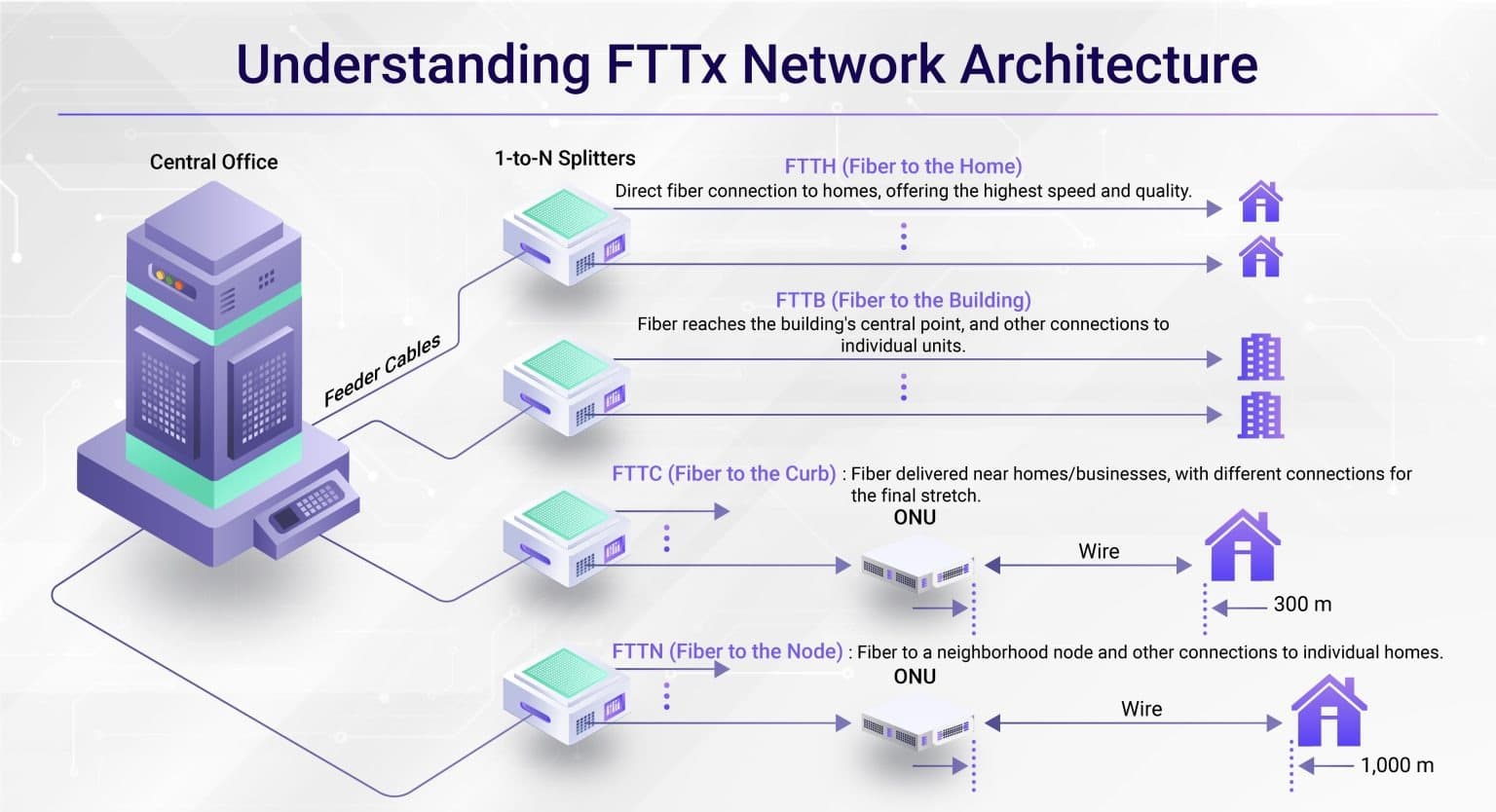
FTTX is a family of network architectures rather than a single one. The X marks where the fibre stops and something else takes over: the home, the building, the kerb or a street cabinet. The closer that termination point sits to the subscriber, the more of the connection's performance comes from the fibre and the less from the copper behind it.
Why fibre wins on physics
Capacity. Optical fibre carries far more data than copper over far greater distances, and the headroom above current service tiers is large enough that capacity is rarely the binding constraint.
Longevity. The cable itself has a long service life, and upgrades are usually a matter of changing the electronics at each end rather than replacing what is in the ground. The expensive part of a fibre build is the civil work, and that work is done once.
Latency. Signal propagation is fast and, more importantly, consistent, which matters for anything interactive.
Stability. Fibre is immune to electromagnetic interference and largely indifferent to the moisture and temperature swings that degrade copper. Fewer weather-correlated faults means fewer truck rolls.
The variants
FTTH takes fibre to the property and delivers the highest and most consistent service, which is what makes it the reference point for residential broadband.
FTTB terminates at a building's entry point, with an internal distribution network beyond it. This suits apartment blocks and business premises where running fibre to every unit is impractical.
FTTC and FTTN stop at a kerbside cabinet or a node and use existing copper for the final stretch. Performance depends heavily on how long that stretch is, which is why these are usually transitional rather than final designs.
Where the difficulty actually is
Fibre's technical case has not been in doubt for years. The hard parts of a build are elsewhere: obtaining wayleaves and permits, coordinating civil works, and the cost per premises passed, which varies enormously with density and ground conditions. Passing a premises is also not connecting one, and the gap between homes passed and homes connected is where a lot of business cases quietly fail.
Operations changes shape too. A fibre network produces fewer faults than copper but different ones, and diagnosing a break or a degrading span calls for different tooling and different field skills than the network it replaced.
Running it once it is built
Once fibre is in the ground the operator's problem shifts from deployment to managing subscribers on it at scale. That means provisioning connections without a technician visit, keeping service records aligned with what is physically installed, and knowing which subscribers a given fault affects before the calls arrive.
Jaze ISP Manager covers that operational side, from subscriber onboarding and provisioning through to billing and network visibility, so a growing fibre footprint does not require a proportional increase in the people managing it.