Smarter Support: A Practical Guide to AI in Customer Service
What AI genuinely handles well in a support queue, where it earns its place, and the failure modes worth designing around before deploying it.
AI in support gets described either as a replacement for the team or as a gimmick. Neither holds up in practice. What it does reliably is absorb the repetitive part of the workload so that the people doing the job spend their time on the cases that actually need judgement.
What it is good at
Speed. Immediate responses to questions that have a definite answer, and routing that puts a case in front of the right person first time.
Volume. Handling routine contacts across every channel at once, including the hours when nobody is on shift.
Pattern recognition. Reading tone, spotting a case that is going wrong, and surfacing context an agent would otherwise have to go looking for.
The framing that matters is that these support the team rather than substitute for it. The moment a customer needs a decision made, the useful thing is a person with the context already in front of them.
Where it earns its place
Handling the repetitive contacts. A large share of any support queue is the same handful of questions: where is my order, how do I reset this, what is my current plan. Answering those automatically is not a degraded experience, because the answer is the same whoever gives it. What matters is that the handover works when the case turns out not to be routine.
Preparing the agent. The most useful applications are not customer-facing at all. Pulling account history, previous contacts and current service state into one view before the agent starts saves the few minutes per ticket that otherwise go on searching, and it removes the need to ask the customer to repeat themselves.
Reading sentiment. Detecting frustration lets a case be escalated before it becomes a complaint. Aggregated, the same signal shows a problem with a product or a recent change while it is still early.
Drafting. Suggested replies that an agent edits are faster than composing from scratch and more consistent than everyone writing their own version, as long as the agent remains the one who decides what is sent.
Summarising. A long thread condensed at handover means the next person starts informed rather than reading from the beginning.
Finding the pattern. Ticket volume by cause is a better guide to what to fix than individual complaints, and categorising it is exactly the kind of work that does not need a person.
What to be careful about
Confident wrong answers are the main risk. A system that fabricates a plausible policy causes more work than it saves, and the customer has no way to tell. Anything customer-facing needs a clear boundary around what it will attempt and a clean route to a person when it reaches that boundary.
Escalation is the second. The common failure is not a bot that cannot answer, it is a bot that will not let go, and customers remember that far longer than they remember a fast answer.
Data handling is the third, particularly where support records contain account details, addresses or usage history.
For an ISP specifically
Support volume tends to concentrate in a few causes: service down, speed slower than expected, billing queries, and a connection that works intermittently. The first three are largely answerable from data the operator already holds, which is what makes them suited to automation.
The constraint is whether that data is reachable. An assistant that cannot see current session state, plan details and recent faults has nothing to work from and will guess. One that can see them can resolve a large share of contacts before a person is involved, and hand over the rest with the diagnosis already attached.
That is a systems question rather than an AI question, and it is usually the one that decides whether any of this works.
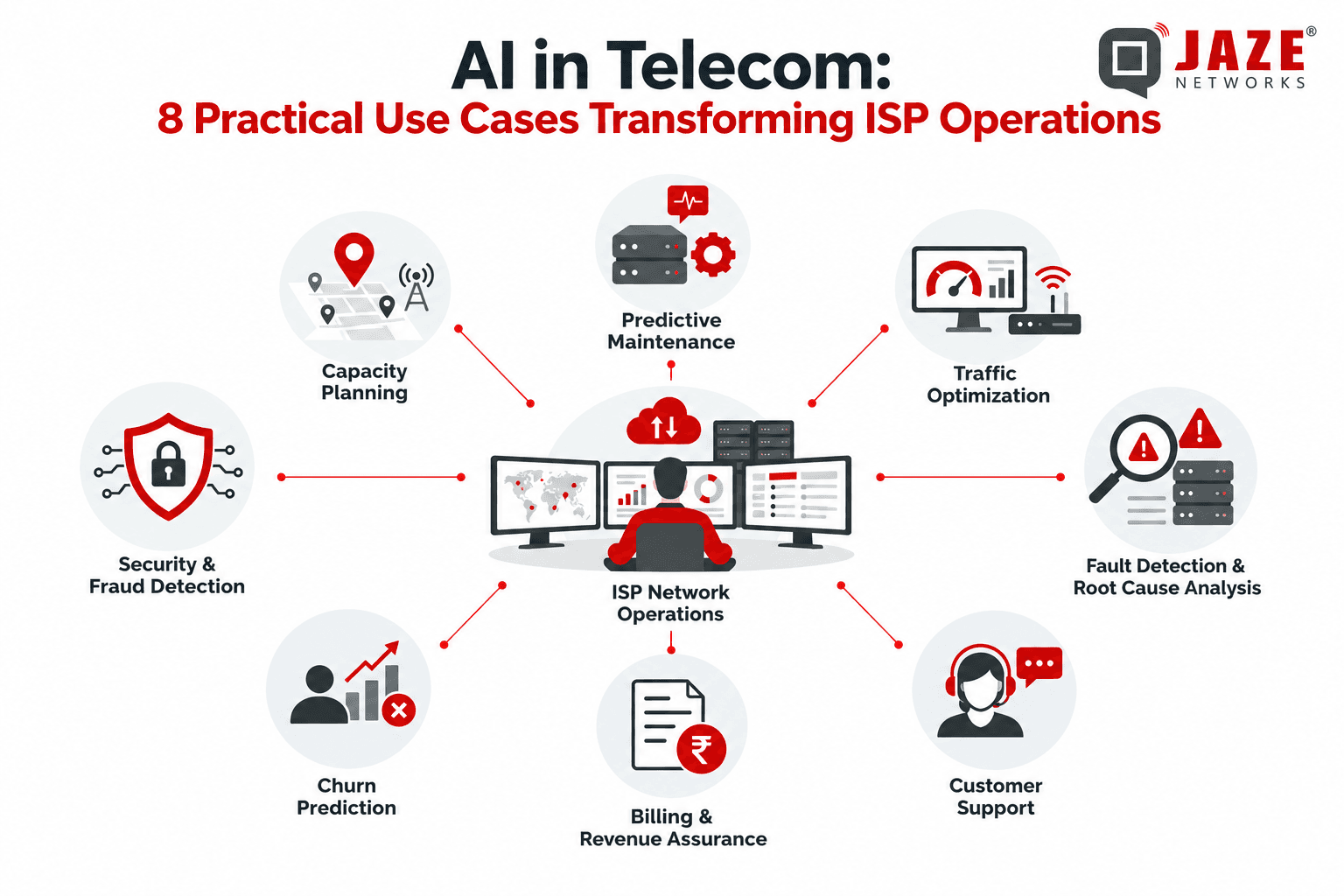
Jaze ISP Manager is designed to reduce that support load. It creates tickets automatically through IVR and chatbot integrations, gives subscribers round-the-clock help through a multilingual self-care portal and mobile app, routes and prioritises issues with AI-driven workflows, and keeps leads, payments and inventory in one system.