Navigate India's New Telecom Authorisation Framework: What Every ISP Must Know in 2026
India replaced the Unified Licence with an authorisation framework under the Telecommunications Act, 2023. What changed for ISPs and VNOs, and how to prepare.
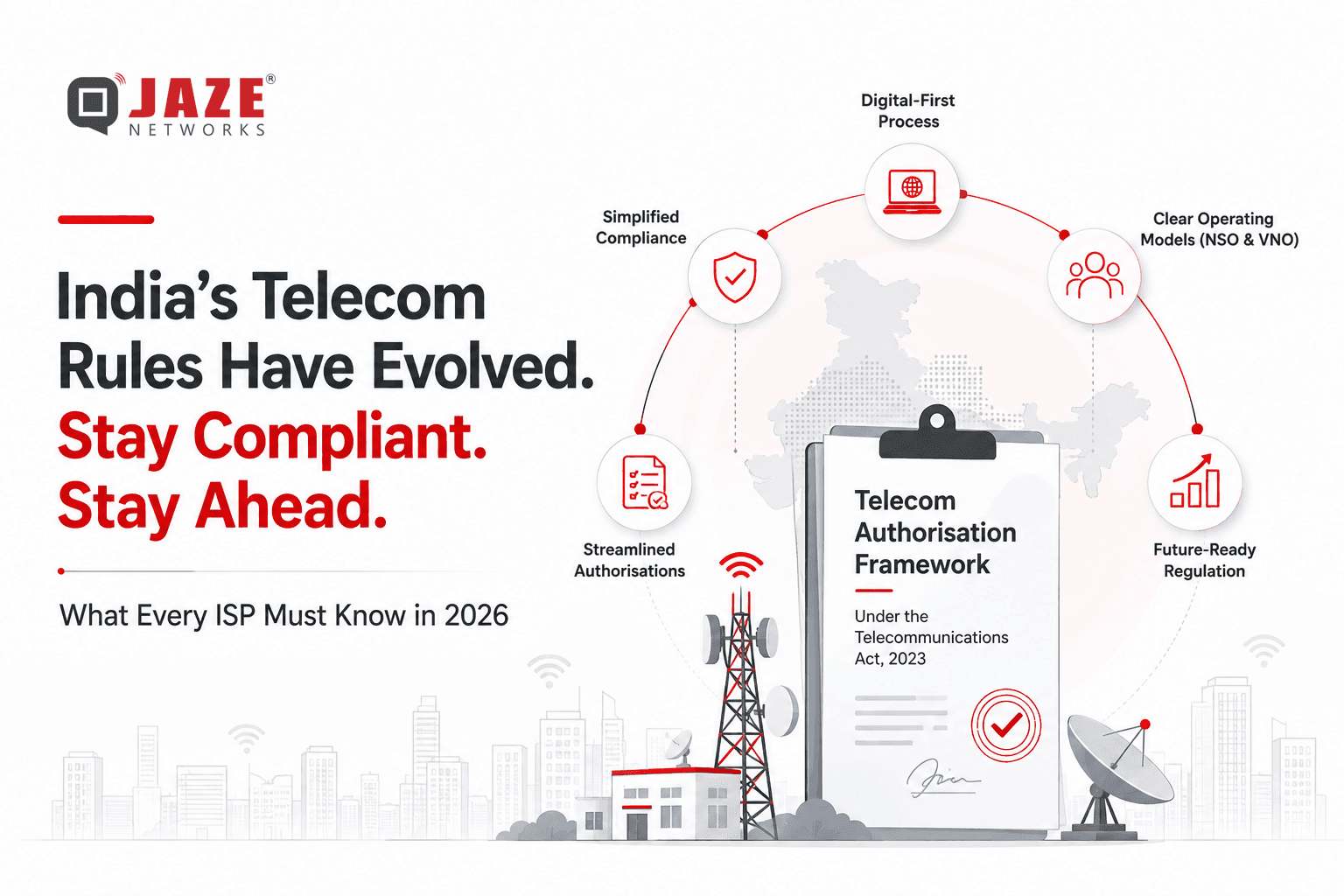
Table of contents
India's telecom sector has moved from the Unified Licence framework to a new authorisation model under the Telecommunications Act, 2023. It is one of the biggest regulatory changes the industry has seen in decades, and it affects Internet Service Providers, telecom operators and Virtual Network Operators alike. Here is what changed, why it matters, and how to prepare.
Why did India replace the ISP licence system?
The traditional licensing framework was designed for a voice-centric telecom industry. As the sector expanded into fibre broadband, cloud services, enterprise connectivity, IoT, private networks and satellite communications, managing all of it under multiple licences created real administrative complexity.
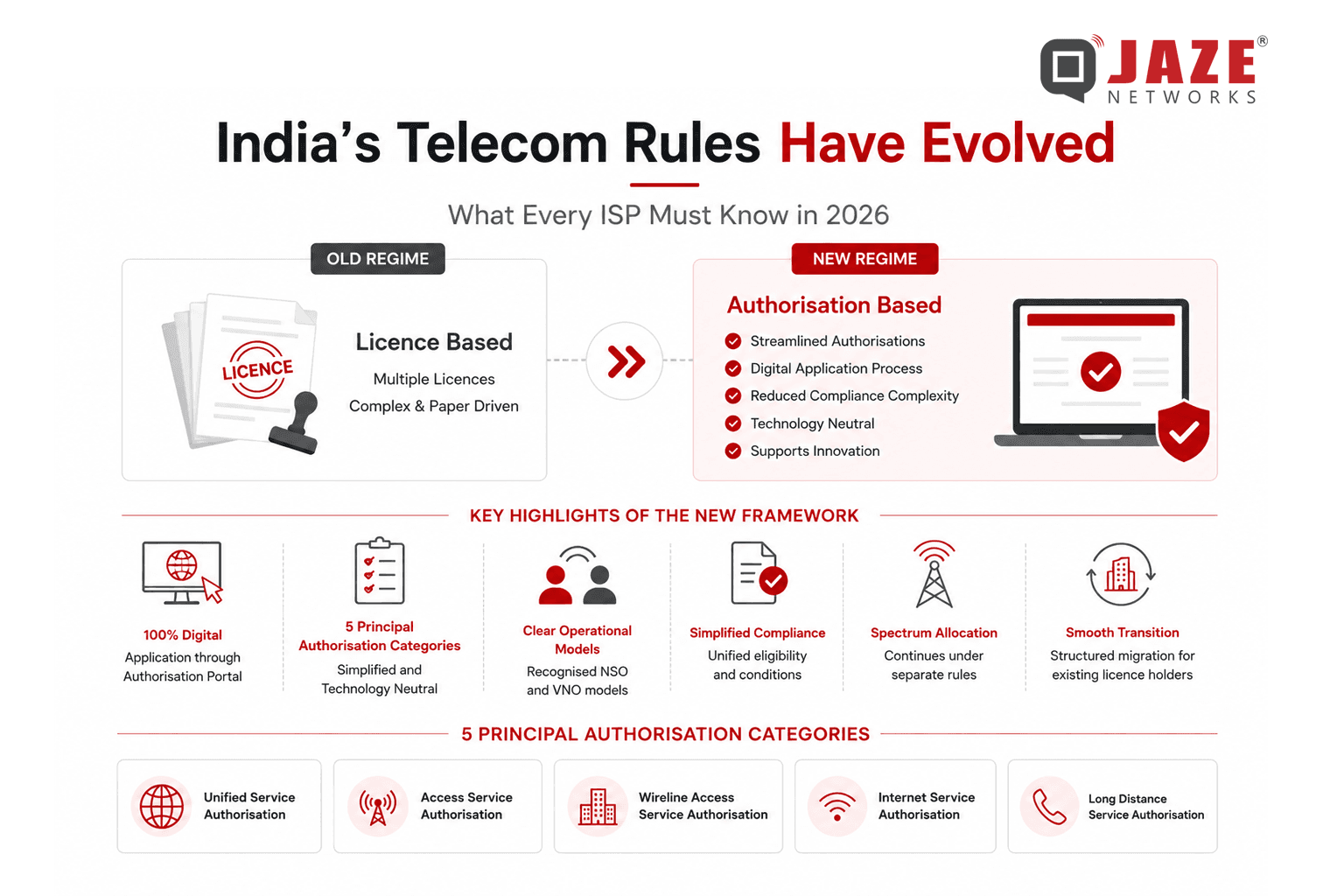
The Department of Telecommunications introduced the Telecommunications (Authorisation for Provision of Principal Telecommunication Services) Rules, 2026 to replace the licence-based approach with a statutory authorisation framework. Its stated objectives are to:
- Streamline regulatory compliance
- Enhance ease of doing business
- Digitise approval workflows
- Establish technology-neutral regulation
- Enable future telecom innovation
Licence versus authorisation: what is the difference?
Under the previous model, operators received licences governed by contract. The new framework grants a government authorisation once prescribed eligibility criteria are satisfied.
Instead of multiple licence documents and a trail of amendments, a unified statutory framework now governs operations. That reduces overlapping documentation and makes obligations easier to read.
A fully digital application process
A dedicated Authorisation Portal lets applicants:
- Submit telecom authorisation applications
- Upload required documentation
- Receive approvals
- Manage compliance submissions
- Migrate existing licences
The intent is to shorten processing timeframes while improving transparency.
New categories replace multiple licence structures
Rather than maintaining numerous licence types, five principal authorisation categories now organise telecom services:
- Unified Service Authorisation
- Access Service Authorisation
- Wireline Access Service Authorisation
- Internet Service Authorisation
- Long Distance Service Authorisation
The structure makes it easier for an operator to identify which authorisations apply, and reduces regulatory overlap between them.
Clear recognition of NSOs and VNOs
The framework draws a clean line between two operating models.
A Network Service Operator (NSO) builds, owns and manages telecom infrastructure: fibre networks, switching systems and transmission equipment.
A Virtual Network Operator (VNO) delivers telecom services by leasing infrastructure from an NSO, which allows market entry without substantial physical network investment.
The distinction helps businesses pick the model that matches their investment strategy and operational goals.
What happens to existing ISP licence holders?
Existing licence holders are not required to stop operating. A structured migration process allows a transition from the legacy Unified Licence framework to the new authorisation regime at the appropriate time. Migration applications run through the Department of Telecommunications Authorisation Portal, and service continuity is maintained throughout.
Simplified compliance requirements
Consolidating eligibility and compliance requirements replaces references to multiple guidelines and amendments with a single framework covering:
- Financial eligibility criteria
- Net worth requirements
- Foreign investment compliance obligations
- Regulatory obligations
- Authorisation conditions
For businesses expanding across several telecom services at once, that removes a significant amount of uncertainty.
Spectrum allocation still follows separate rules
One point deserves emphasis: authorisation does not automatically grant spectrum access. Spectrum assignment continues through independent government allocation mechanisms, and organisations must satisfy separate spectrum-related requirements where they apply.
Why this matters for ISPs
For Internet Service Providers, the reforms offer less administrative load, better transparency, and a clearer path into new service categories. As broadband demand grows across residential, enterprise, rural and industrial segments, a simplified regulatory framework supports faster deployment without procedural drag.
The framework also aligns with India's wider investments in fibre infrastructure, digital public services, 5G expansion and future communication technologies.
Preparing for the transition
Practical preparation comes down to five steps:
- Determine which authorisation applies to your services
- Review eligibility and financial requirements
- Plan migration from legacy licences where applicable
- Update internal compliance processes
- Monitor future Department of Telecommunications notifications
Starting early minimises disruption while keeping you compliant with the requirements that apply today.
Conclusion
The move from telecom licences to a modern authorisation framework is more than a procedural adjustment. It reflects India's intent to build a digitally-enabled, innovation-friendly telecom ecosystem.
For ISPs, telecom operators and VNOs, the change introduces a more transparent, technology-neutral and digitally managed regulatory environment. Adapting takes planning, but the longer-term gains are streamlined compliance, better operational efficiency and a stronger position in India's expanding digital economy.
Platforms like Jaze ISP Manager carry much of the operational weight that sits underneath these obligations, covering subscriber management, billing, AAA, CRM, inventory, franchise management and the network operations records compliance depends on.