Evaluating CGNAT and IPv6: Architectural Limitations, Performance Impact, and Long-Term Viability
What carrier-grade NAT costs in exchange for extending IPv4, what IPv6 restores, and why most operators end up running both for a long time.
Every connected device needs an address. For decades that came from IPv4, a 32-bit scheme that was more than sufficient while the internet was small. It stopped being sufficient some time ago, and the industry's response has taken two forms: a workaround that extends IPv4, and a replacement that removes the constraint entirely.
Why carrier-grade NAT exists
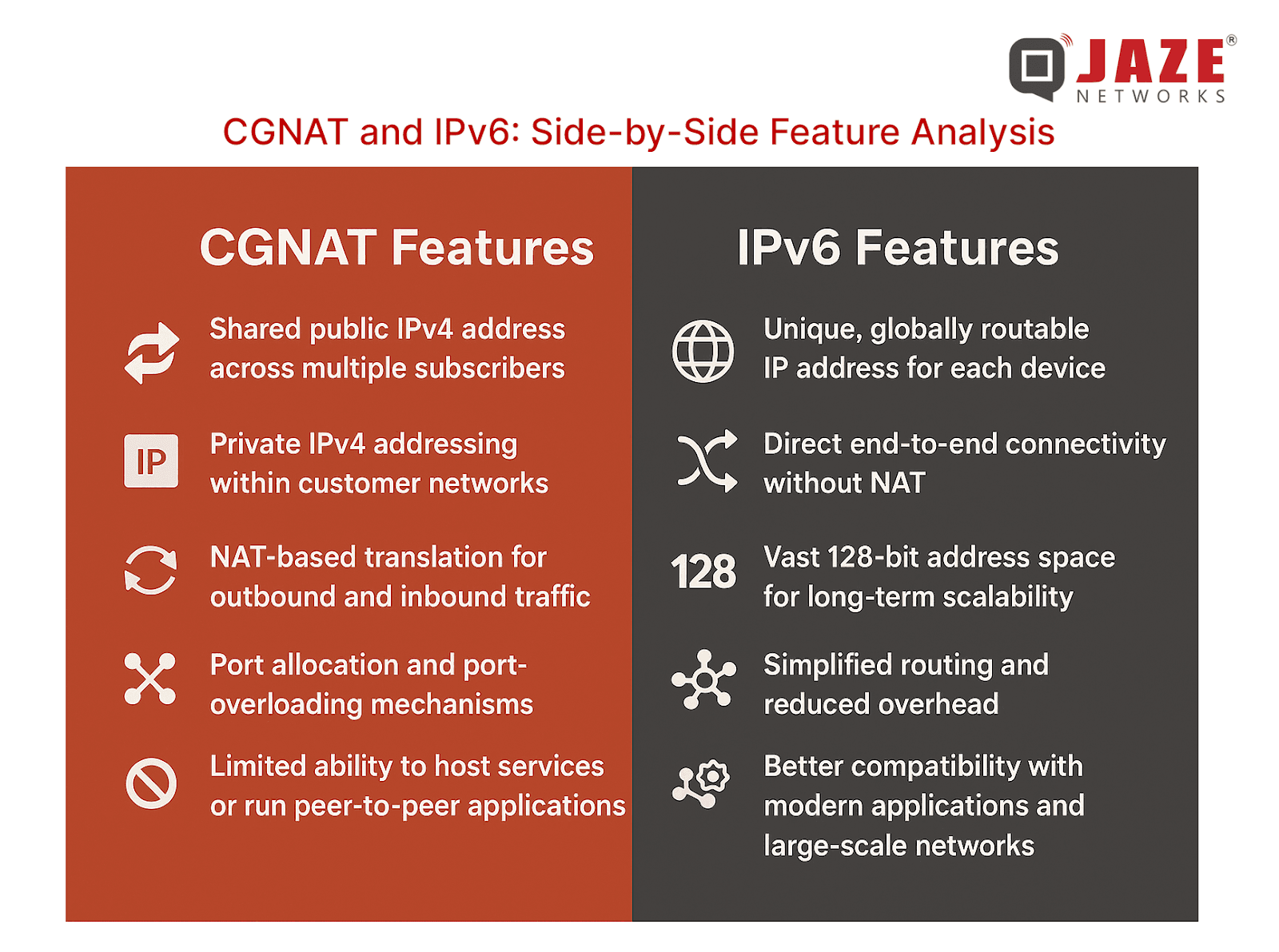
Rather than give every subscriber a public address, carrier-grade NAT has many subscribers share one. Each household gets a private address internally, and a translation layer maps their traffic onto the shared public address on the way out.
It works, and it bought the industry a considerable amount of time. It also breaks the assumption the internet was designed around, which is that any host can reach any other host directly. Once a translation device sits in the middle of every connection, some things stop working properly.
Port forwarding becomes difficult and sometimes impossible, which affects anyone running a service at home, using remote access, or relying on peer-to-peer applications. Abuse handling gets harder too: when hundreds of subscribers share a public address, attributing a complaint to one of them requires correlating translation logs rather than simply reading an address.
What IPv6 changes
IPv6 uses 128-bit addressing, which provides enough unique public addresses that scarcity stops being a design consideration.
The more meaningful change is architectural. With enough addresses to go around, every device can be globally reachable and the translation layer disappears. That means simpler network design, fewer moving parts in the path, and better behaviour for anything that depends on direct connectivity.
Adoption has been slower than anyone predicted. A great deal of infrastructure is still IPv4-first, support across devices and applications remains uneven, and IPv6 is sometimes deployed with the habits of IPv4 carried over, including NAT, which gives up much of the benefit.
Where the difference shows
Remote access and self-hosting. Reaching a device at home is awkward behind CGNAT and straightforward with a public IPv6 address.
Real-time applications. Games, voice and video calls all have to negotiate their way through NAT, which adds setup latency and a category of failure that does not otherwise exist.
Connected devices. Direct, secured access to a device is simpler without relay mechanisms standing in for reachability.
Abuse investigation. A shared address obscures which subscriber did what. IPv6 makes attribution cleaner, provided logging and privacy handling are designed properly.
Running both
In practice most operators run dual-stack for an extended period, offering IPv6 where it works and falling back to IPv4 where it does not. That is the pragmatic position: CGNAT keeps existing services reachable while IPv6 coverage grows, and neither has to be switched off abruptly.
The cost is that the operator maintains two addressing regimes at once, with the translation infrastructure, logging obligations and support burden of the older one alongside the newer.
That makes the subscriber record the place where both have to reconcile. An account may hold a shared IPv4 address, a delegated IPv6 prefix, or both, and support and compliance work depends on being able to see which applied at a given moment. Session and flow records carrying NAT translation detail are what make that answerable.