Bufferbloat: Why QoS Priority Isn't Enough and How FQ-CoDel Improves BNG Performance
Why oversized queues add latency even on fast connections, why QoS priority alone cannot fix it, and how FQ-CoDel and AQM in Jaze BNG keep queues short under load.
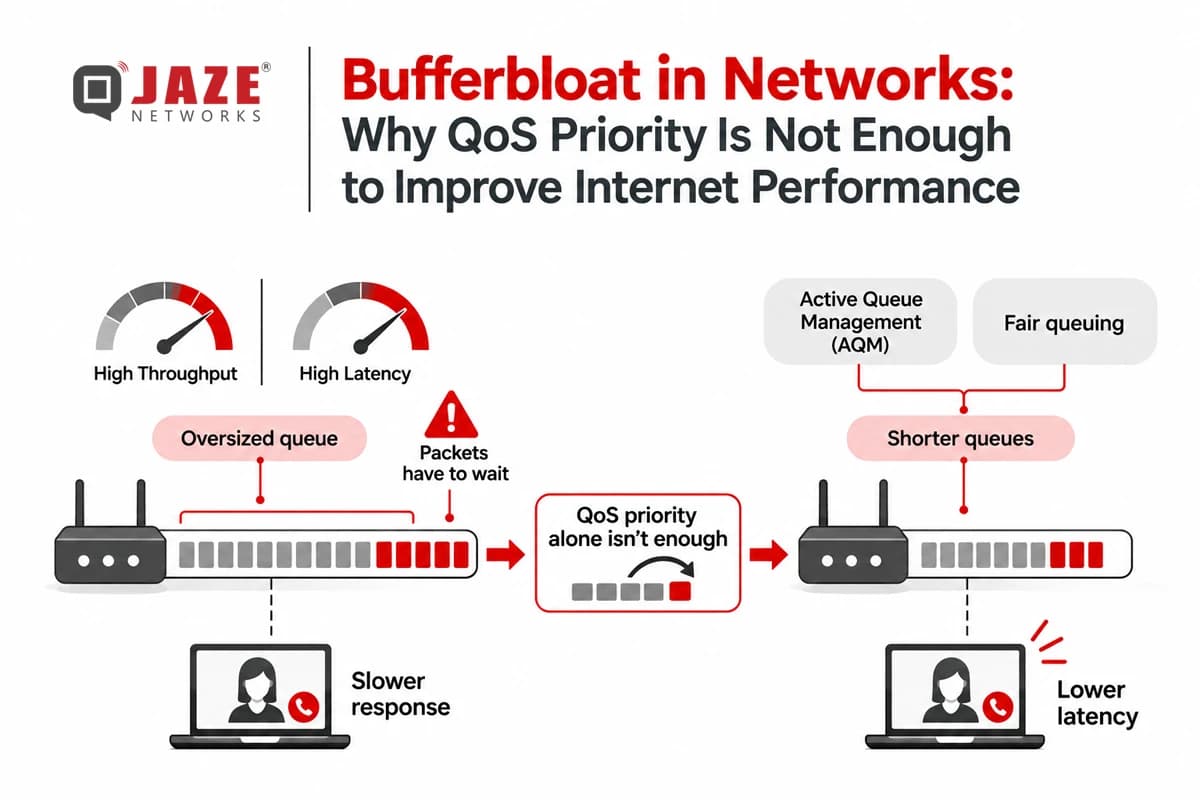
Table of contents
A broadband connection can deliver high speeds and still suffer from poor performance. Video calls may freeze during large downloads, online games may experience lag, and web pages may take longer to respond. The problem is not always insufficient bandwidth. It can also be caused by excessive packet delay within network queues.
This is known as bufferbloat. For Internet Service Providers (ISPs), managing this problem is essential to delivering a consistent subscriber experience.
Jaze BNG addresses this challenge using FQ-CoDel and Active Queue Management (AQM), helping ISPs manage network queues more efficiently and improve performance under load.
What is bufferbloat in broadband networks?
Bufferbloat occurs when network equipment maintains excessively large queues of packets, causing them to wait too long before transmission.
Routers and Broadband Network Gateways (BNGs) use buffers to temporarily store packets when incoming traffic exceeds the rate at which the outgoing link can transmit them.
Buffers are necessary to handle short traffic bursts. However, when a queue remains full for extended periods, packets experience increased latency.
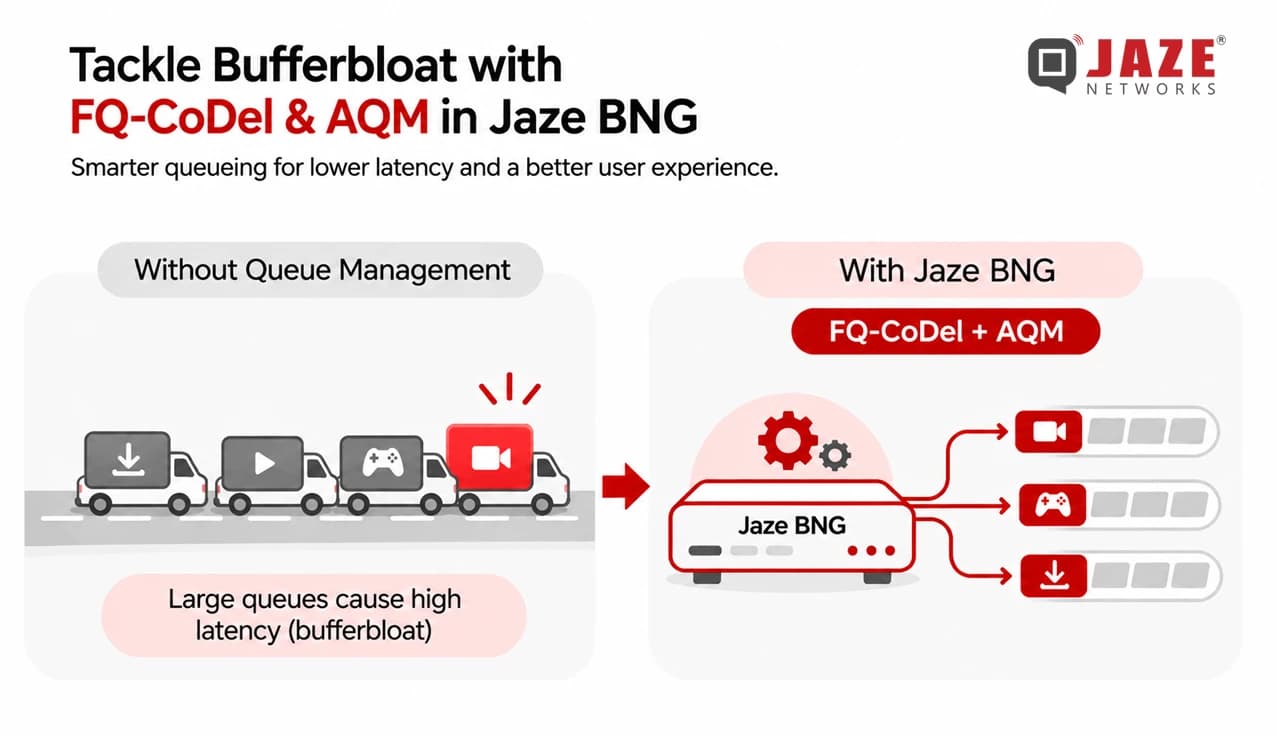
Consider a subscriber downloading a large file while attending a video conference. Both activities share the available network capacity. If packets are placed in one large queue, the video conference packets may have to wait behind packets from the download.
The connection may still deliver its advertised speed, but the increased waiting time affects real-time applications.
This is why bufferbloat can cause poor application performance even when bandwidth appears sufficient.
Why QoS priority alone cannot eliminate bufferbloat
Quality of Service (QoS) helps networks manage different types of traffic based on their importance.
For example, voice and video traffic can receive higher priority than bulk downloads. This helps latency-sensitive applications access network resources more quickly.
However, prioritisation does not automatically control how long packets remain in a queue. If packets are already waiting in a large queue, priority alone may not resolve the underlying delay. Traffic that is not prioritised can also experience unnecessary waiting time.
QoS determines which packets should be served first. Queue management determines how much delay builds up before packets are served. Both are important for maintaining network performance.
For ISPs, relying only on traffic prioritisation may leave an important part of the latency problem unresolved.
How active queue management (AQM) reduces network latency
Active Queue Management is designed to prevent network queues from remaining excessively full.
Traditional queue management often waits until a buffer reaches its capacity before dropping packets. This can create long delays before congestion becomes visible to traffic sources.
AQM monitors queue conditions and can signal congestion before the buffer overflows.
Depending on the algorithm and network support, this may involve dropping packets or marking them using Explicit Congestion Notification (ECN). These signals help responsive traffic sources reduce their sending rate.
The objective is to maintain enough buffering to handle traffic bursts without allowing persistent queues to create unnecessary latency.
CoDel, or Controlled Delay, is an AQM algorithm that uses packet sojourn time (the time a packet spends waiting in a queue) to identify persistent queueing delay.
Rather than relying only on queue size, CoDel responds to how long packets have been waiting. This makes queue management more responsive to changing network conditions.
What is FQ-CoDel? Combining fair queueing and AQM
FQ-CoDel combines two complementary mechanisms: Flow Queueing and Controlled Delay.
Flow Queueing separates traffic into multiple queues, generally using packet flow information. A scheduler then serves these queues in turn, reducing the extent to which one large traffic flow can dominate the transmission queue.
CoDel operates on these individual queues to manage persistent delay.
This combination addresses two separate problems.
Flow Queueing reduces interference between traffic flows. A large download is less likely to force unrelated, low-volume traffic to wait behind its entire backlog.
CoDel manages queueing delay within individual flows. It responds when packets remain queued for too long, helping prevent persistent bufferbloat.
FQ-CoDel therefore does more than simply prioritise selected traffic. It combines flow-based scheduling with active queue management to maintain more efficient queues.
How Jaze BNG uses FQ-CoDel and AQM for efficient queueing
Jaze BNG uses FQ-CoDel and AQM to support efficient queue management in broadband networks.
By combining flow-based scheduling with active queue management, Jaze BNG helps address the delay caused by persistent packet queues.
This approach is particularly relevant in subscriber networks where multiple applications compete for available bandwidth.
For example, when a subscriber downloads a large file while making a voice call, flow-based queueing helps prevent the download from dominating the queue. AQM helps manage persistent delay within the queues.
The result is more efficient packet handling and improved responsiveness under network load. For ISPs, this supports a better balance between high-throughput applications and latency-sensitive services.
Why efficient queue management matters for ISPs
Network performance is not measured by bandwidth alone.
Subscribers also depend on low latency, stable application response times, and consistent performance when their connections are busy.
Bufferbloat can affect several common activities:
- Video conferencing and voice calls may experience increased delay.
- Online gaming may become less responsive.
- Web browsing and interactive applications may take longer to respond.
- Large downloads and uploads may interfere with other applications.
Efficient queue management helps reduce these effects by controlling persistent queueing delay and improving how competing flows share network resources.
It does not create additional bandwidth, but it helps make better use of the capacity available.
Improve broadband performance with Jaze BNG
For broadband service providers, delivering a reliable subscriber experience requires more than increasing bandwidth or assigning traffic priorities. Effective queue management is equally important.
Jaze BNG uses FQ-CoDel and AQM to support efficient packet scheduling, manage queueing delay, and improve network responsiveness under load.
By addressing both flow isolation and persistent queueing delay, ISPs can provide a more consistent experience across different applications.
With Jaze BNG, ISPs can take a more effective approach to bufferbloat management, because better broadband performance depends not only on how much bandwidth is available, but also on how efficiently packets are queued and transmitted.