




What if an internet service provider could identify a recurring network problem before it triggered hundreds of customer complaints? Or resolve routine support requests without requiring a technician to investigate every ticket manually?
These possibilities are driving interest in artificial intelligence (AI) in telecom. As broadband networks become more complex and subscriber expectations continue to rise, AI offers new ways to analyze network data, streamline operations and improve customer experiences.
According to the Telecom Regulatory Authority of India (TRAI), India’s telecommunications ecosystem continues to evolve alongside growing digital connectivity. Industry research from GSMA Foundry also highlights AI deployments across network operations, automation and customer service.
For internet service providers (ISPs), the opportunity is not simply to adopt another technology. It is to identify where intelligent automation can solve everyday operational challenges.
What Is AI in Telecom?
AI in telecom refers to the use of machine learning, predictive analytics, natural language processing and other AI techniques to improve telecommunications networks and business operations.
These technologies can analyze large volumes of information, identify patterns, generate recommendations and assist with repetitive tasks. Depending on the application, AI may support human decision-making or automate specific actions under defined controls.
For ISPs, practical applications span network monitoring, fault detection, customer support, billing analysis, capacity planning and fraud detection.
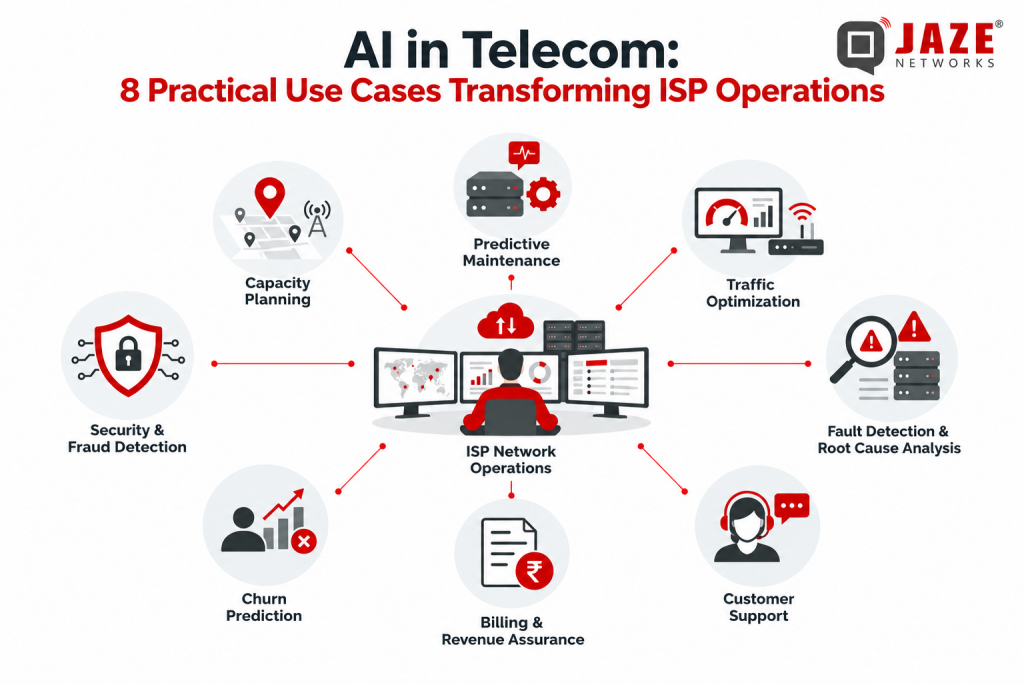
8 Practical AI Use Cases in the Telecom Industry
1. Predictive Network Maintenance
Traditional network maintenance often begins after a fault occurs or customers report connectivity problems. AI can help operators take a more proactive approach.
By analyzing historical fault records, equipment telemetry and recurring incident patterns, machine learning models can identify warning signs associated with potential failures.
For example, repeated alarms from a network device combined with previous outage patterns could indicate that an engineer should investigate before the issue escalates.
Benefit for ISPs: Earlier intervention, fewer avoidable disruptions and better maintenance planning. Predictions must be validated against actual equipment conditions and reliable operational data.
2. Intelligent Network Traffic Optimization
Internet traffic changes throughout the day. Residential usage may increase during evenings, while businesses have different peak periods.
AI-based analytics can study traffic patterns, utilization levels and historical demand to help operators anticipate congestion and plan network capacity.
These insights can support decisions about bandwidth allocation, capacity upgrades and traffic engineering. Automated changes, where supported, should follow established network policies and safeguards.
Benefit for ISPs: Better resource utilization, more informed capacity planning and improved consistency during periods of high demand.
3. Automated Fault Detection and Root Cause Analysis
A single connectivity issue can generate multiple alarms across routers, access equipment and monitoring systems. Identifying the underlying cause manually can take valuable time.
AI can correlate related events, compare current incidents with historical cases and help narrow down likely causes.
For instance, several complaints from subscribers connected to the same access device may indicate a shared infrastructure problem rather than individual home-router faults.
Benefit for ISPs: Faster investigation, more focused troubleshooting and reduced dependence on manual alarm analysis.
4. AI-Powered Customer Support
Customer support teams handle recurring questions about outages, installation schedules, plan details, payments and connectivity troubleshooting.
AI chatbots and conversational assistants can answer common questions, guide customers through basic diagnostic steps and collect relevant information before escalating complex cases.
Generative AI can also help support agents summarize long conversations and retrieve information from approved knowledge bases.
Benefit for ISPs: More accessible support, consistent responses and additional time for staff to focus on complex customer issues.
Human escalation remains essential when a problem requires technical judgment, account verification or a field visit.
5. Smarter Billing and Revenue Assurance
Billing discrepancies can arise from incorrect plan assignments, outdated subscriber records, missed service changes or inconsistencies between usage data and invoices.
AI can help identify unusual patterns, flag potential anomalies and prioritize records for review. Predictive analytics may also highlight recurring billing issues that deserve investigation.
For example, an unexpected increase in adjustments associated with a particular plan could prompt a review of the relevant billing workflow.
Benefit for ISPs: Better visibility into discrepancies, more efficient auditing and improved revenue assurance.
AI-generated flags should be treated as leads for investigation, not proof of fraud or billing errors.
6. Customer Churn Prediction
Subscribers may consider switching providers because of recurring outages, unresolved complaints, poor communication or pricing concerns.
AI models can analyze historical support interactions, service interruptions and other appropriately collected customer data to identify patterns associated with cancellations.
An ISP can then investigate at-risk accounts and offer relevant assistance, such as resolving a recurring fault or clarifying a billing issue.
Benefit for ISPs: More targeted retention efforts and opportunities to address dissatisfaction before customers leave.
Predictions should support fair, transparent customer service rather than intrusive profiling.
7. Fraud Detection and Network Security
Telecom operators must protect their infrastructure and revenue from suspicious activity, account misuse and unauthorized access.
AI-based anomaly detection can help identify unusual login patterns, unexpected usage changes or traffic behaviour that differs significantly from established baselines.
When combined with conventional security controls, these signals can help teams prioritize investigations and respond more efficiently.
Benefit for ISPs: Earlier identification of suspicious activity and more focused security monitoring.
AI cannot replace access controls, secure configurations, incident response procedures or established network security practices.
8. AI-Assisted Capacity Planning
Expanding a broadband network requires decisions about where demand is likely to grow and when additional infrastructure may be needed.
AI and predictive analytics can combine historical subscriber growth, utilization trends, service requests and geographic demand indicators to help operators compare expansion scenarios.
For example, an ISP could use these insights alongside feasibility surveys and existing network maps to prioritize areas for further investigation.
Benefit for ISPs: More informed investment decisions, improved resource planning and better alignment between network expansion and customer demand.
Forecasts should be checked against local conditions, deployment costs and actual subscriber uptake.
How Can ISPs Start Implementing AI?
Successful AI adoption begins with a clearly defined operational problem—not the technology itself.
ISPs can start with these steps:
- Identify a measurable challenge: Choose a problem such as repetitive support queries, lengthy fault investigations or recurring billing discrepancies.
- Review data quality: Check whether network records, tickets, subscriber information and historical incidents are accurate and accessible.
- Run a focused pilot: Test one use case against an established baseline and measure its impact.
- Keep appropriate human oversight: Require approval for consequential changes to network configurations, customer accounts or billing.
- Measure outcomes: Track indicators such as resolution time, repeat incidents, prediction accuracy and operational effort before expanding deployment.
Data privacy, cybersecurity, integration costs and staff readiness should also be considered from the beginning.
AI in telecom is moving beyond experimentation into practical applications across network operations, customer service and business management. For ISPs, the greatest value comes from applying it to specific problems, measuring the results and integrating it responsibly into existing workflows.
AI is not a substitute for reliable infrastructure or sound operational processes. It is an additional tool that can help teams make better use of the data and resources they already have.
Manage ISP Operations with Jaze ISP Manager
AI can help ISPs identify patterns and make informed decisions, but those insights are most useful when day-to-day operations are organized and connected. Jaze ISP Manager helps internet service providers manage subscriber operations, billing and helpdesk workflows through a unified platform.
Explore how Jaze Networks can help your team streamline routine processes and manage a growing broadband subscriber base.