Optimizing Your Streaming Bandwidth: Essential Tips for Smooth Performance
What actually determines a stream's bandwidth requirement, how to work out your own, and the levers that free up capacity without losing quality.
Bandwidth is the volume of data a connection can carry in a given period. For streaming, the practical question is narrower: how much does a given quality level need, and how much headroom does it need on top.
What determines the requirement
Resolution. More pixels means more data. Each step up from 720p to 1080p to 4K increases the requirement substantially rather than incrementally.
Frame rate. Sixty frames per second carries roughly twice the information of thirty, so a high frame rate stream costs meaningfully more than the same resolution at a lower rate.
Codec. How efficiently the video is compressed changes the requirement more than most people expect. H.265 delivers comparable quality to H.264 at roughly half the bitrate, so the codec in use is as relevant as the resolution.
Connection stability. A steady connection at a lower rate outperforms a faster one that fluctuates, because adaptive streaming responds to instability by dropping quality.
Working out what you need
The arithmetic is straightforward: the video bitrate plus the audio bitrate is the requirement. A 1080p stream at 4 Mbps of video with 0.5 Mbps of audio needs 4.5 Mbps.
What matters more is the headroom on top. Adding somewhere between a quarter and a half again absorbs the ordinary variation in a connection, and without it a stream that theoretically fits will drop quality whenever anything else on the network does something.
Live streaming is less forgiving than on demand. On-demand playback buffers ahead and can ride out a brief dip, whereas a live stream has no future content to draw on and degrades immediately.
Making the most of what you have
Use an efficient codec. Where the encoder and the players support H.265, the same quality costs roughly half the bitrate. This is the single largest lever available.
Match the quality to the screen. 4K on a phone is largely wasted, and dropping to 1080p there frees capacity for everything else in the house.
Prefer a wire where practical. Wireless adds variability that manifests as quality changes mid-stream even when average throughput is adequate.
Watch the upstream direction. For anyone broadcasting rather than watching, upload capacity is the constraint, and it is usually far smaller than the download figure on the same connection.
Check what else is running. Backups, updates and cloud sync compete directly, and quality of service settings that prioritise video address that without anyone having to remember to pause things.
Rough figures
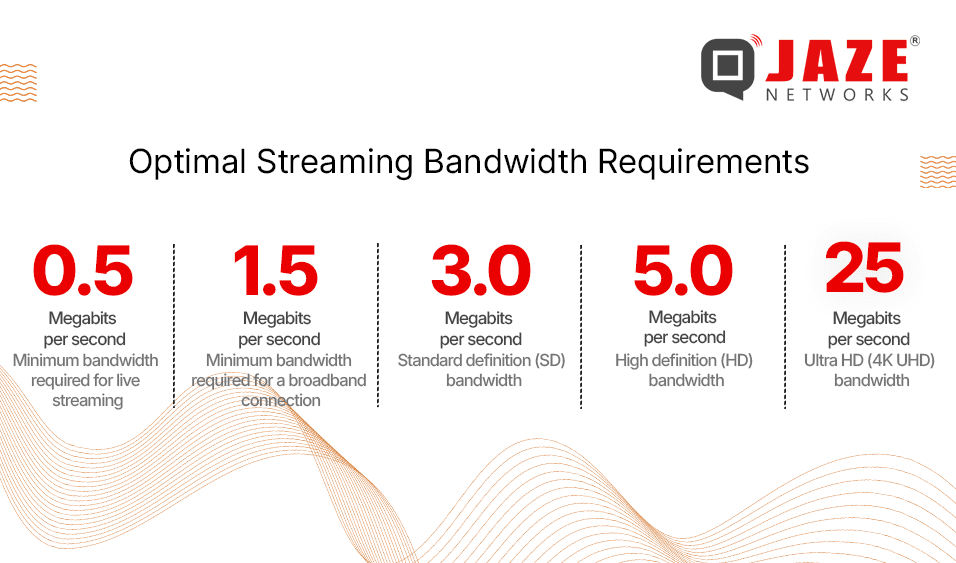
| Quality | Typical requirement |
|---|---|
| 720p at 30 fps | 3 Mbps |
| 1080p at 30 fps | 5 Mbps |
| 1080p at 60 fps | 6–8 Mbps |
| 4K at 60 fps | 25 Mbps |
These are per stream. A household running several at once needs the sum, plus headroom, and platforms differ in their own recommendations.
From an operator's side
Streaming determines the evening peak on most consumer networks, and the shape of that peak is set by content schedules rather than by anything the operator controls.
The useful consequence is that this traffic caches and peers well, since it comes from a small number of large sources. Handling it locally rather than over transit is one of the more reliable ways to reduce both cost and the latency that subscribers experience as buffering.
Jaze ISP Manager monitors bandwidth usage with real-time insight and detailed usage reports, and lets operators troubleshoot Wi-Fi remotely by showing connected devices and signal strength on its dashboard. Usage patterns then point to the adjustments that keep video and audio playing smoothly for subscribers.