MicroPoPs: Supercharging Fiber Networks for Tomorrow's Connectivity
Bringing fibre deep into an area without running it to every door: what a MicroPoP is, why operators use them, and what to be realistic about.
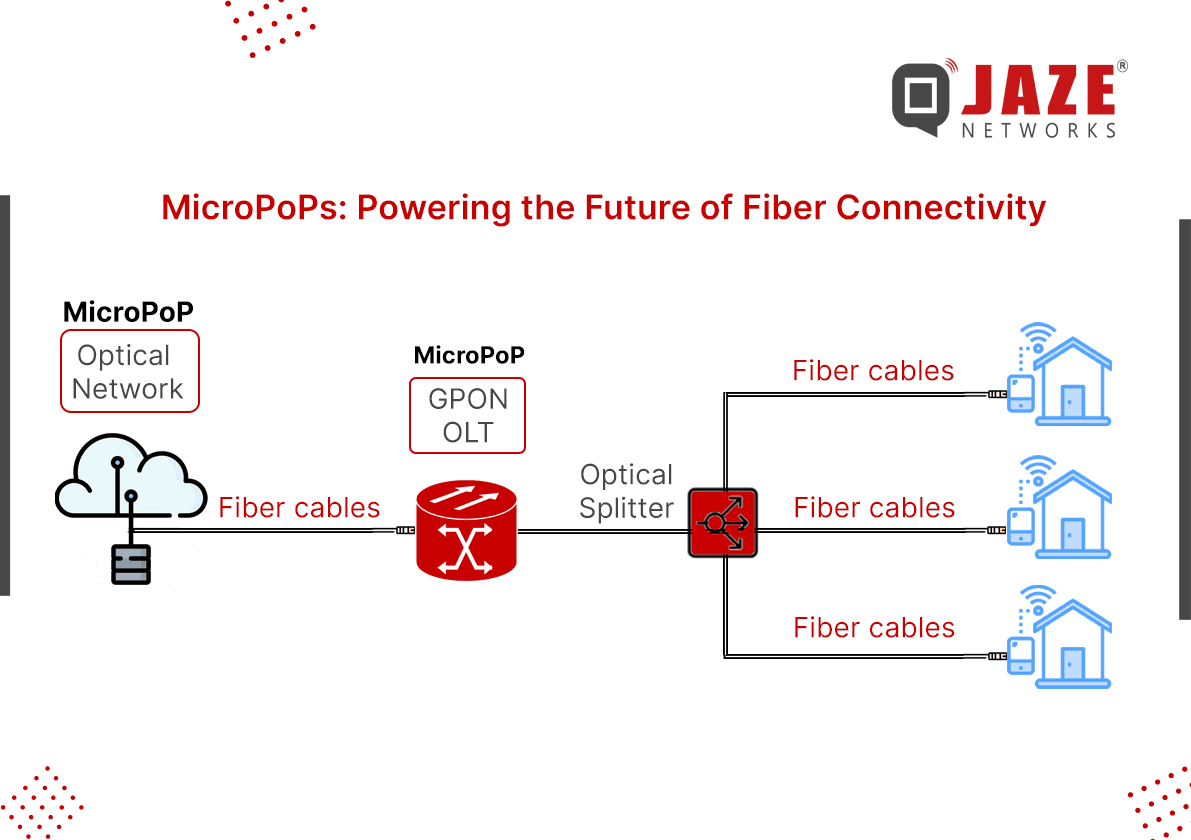
Running fibre to every property is the best network an operator can build and the most expensive way to reach a thinly populated area. A MicroPoP is the compromise that makes the middle ground workable: bring fibre deep into the area, terminate it in a small local node, and cover the remaining short distance by whatever is cheapest there.
What one actually is
A MicroPoP is a small fibre-fed distribution point sited inside the community it serves. It sits between the aggregation network and the subscriber, taking a high-capacity fibre feed and distributing from there over a short final hop.
The distinction from full FTTH is where the fibre stops. FTTH runs it to the premises. A MicroPoP runs it close to the premises and hands off, which removes the most expensive part of the build: the individual drop to each property.
Where it fits
Upstream, a MicroPoP connects to the core through regional fibre or an aggregation point, so the backbone capacity is genuinely there.
Downstream, it feeds whatever suits the local situation. That might be fibre to the kerb or building, or a fixed wireless link where trenching the last stretch is not economic.
Locally, it puts termination closer to subscribers, which shortens the path and reduces the load carried back to a central site.
Why operators use them
Cost. The civil works dominate a fibre build, and they scale with distance and with the number of individual drops. Serving many subscribers from one node avoids a large share of both.
Time. A node can be installed in a fraction of the time a full build takes, often using existing structures, which matters when coverage commitments or competitors set the timetable.
Incremental growth. Capacity is added a node at a time in step with demand, rather than committing to a large build in advance of subscribers who may not appear.
Coverage in awkward places. Semi-urban and suburban areas frequently sit above the density where wireless alone is adequate and below the density that justifies FTTH. This is the case a MicroPoP is designed for.
What to be realistic about
The last hop is what you have chosen to compromise on, and it will determine what a subscriber actually experiences. A fixed wireless final stretch brings weather sensitivity, contention and a capacity ceiling that fibre does not have, and no amount of backhaul capacity compensates for it.
Node siting brings its own practical work: power, physical security, environmental protection and access rights, multiplied across a lot of small locations rather than concentrated in a few large ones.
Operationally, that multiplication is the real change. Many small sites are harder to monitor and maintain than one large one, and a fault at a node affects everyone it serves. Remote visibility stops being a convenience and becomes the thing that keeps field costs down.
The management side
A distributed access network makes subscriber management more demanding rather than less. Subscribers attach through different technologies at different nodes and still expect one service, one plan and one bill, so policy has to apply consistently regardless of how someone connects.
Jaze ISP Manager handles that from one platform, covering authentication, policy and billing across a mixed access network, so the way an area happens to be served does not turn into a separate operational process for each node.