Beyond Smooth Calls: How QoS and QoE Shape Real-Time Communication Success
What the network controls, what the user perceives, why the two come apart in both directions, and which metrics are worth instrumenting.
Real-time communication, whether that is a voice call, a video meeting or a live stream, fails differently from most internet traffic. A web page that arrives half a second late is unremarkable. A call that does the same is noticeably broken. Delivering it well depends on two related but distinct ideas: what the network does, and what the person on the call experiences.
Quality of Service: what the network controls
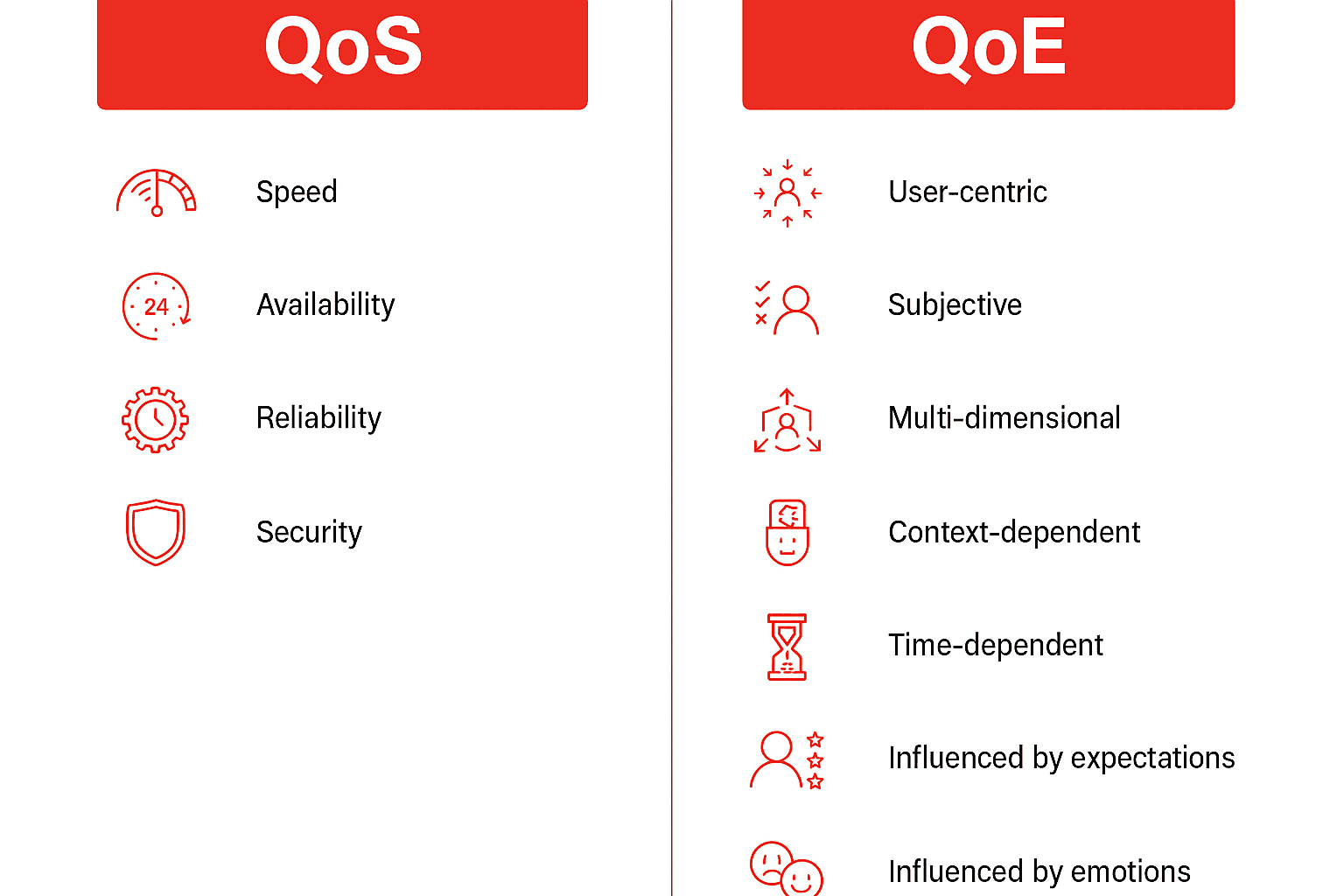
QoS is the set of mechanisms that decide how traffic is treated in transit. Applied to real-time traffic, the relevant ones are:
Bandwidth allocation. Reserving enough capacity that a call is not competing on equal terms with a backup or a software update.
Latency. Keeping one-way delay low enough that conversation stays natural. Past roughly 150 ms people start talking over each other.
Jitter. Delivering packets at consistent intervals. Variable arrival timing is what produces choppy audio, and it does more damage than modest, steady delay.
Packet loss. Real-time media cannot wait for retransmission, so loss shows up directly as a gap. Small amounts are concealed; sustained loss is not.
Prioritisation. Marking and queueing so that time-sensitive traffic is handled ahead of traffic that can afford to wait.
These are all measurable, which is what makes QoS something an operator can engineer against.
Quality of Experience: what the user perceives
QoE is the subjective counterpart. It asks whether the call was good, which is not the same question as whether the packets arrived.
It takes in audio and video clarity, whether the application is straightforward to use, whether the service behaves consistently from one session to the next, and what the user expected in the first place. A brief glitch on a casual call passes unremarked; the same glitch in a client presentation does not.
It is measured differently too, through mean opinion scores, session success rates and user feedback rather than counters on an interface.
Why both are needed
The two come apart more often than people expect, in both directions.
A session can be technically excellent and still be experienced as poor, if the application is confusing, the join process is awkward, or an error message appears without explanation. The network did its job and the user was still dissatisfied.
Equally, a session with measurable impairment can be experienced as fine. Modern codecs conceal a surprising amount, so a small amount of loss may never be noticed.
That gap is the practical argument for measuring both. QoS metrics tell an operator what to fix. QoE indicators tell them whether it was worth fixing, and which of several possible faults is actually costing them subscribers.
What to instrument
On the network side, latency, jitter, loss and the effect of prioritisation policy, measured per class rather than in aggregate, because an average across all traffic hides exactly the problem being looked for.
On the experience side, session establishment success, session duration, abandonment, repeat support contacts, and scores where they can be collected.
The value comes from viewing them together. Jitter that rises at the same hour that call abandonment rises is a lead worth following. Either figure alone is only half an argument.
For an operator, the diagnostic difficulty is that the impairment is often not in their network at all. Per-session flow records are what make it possible to say where a call actually degraded, rather than inferring it from a subscriber's description after the fact.