Upload Speed: A Key Factor in the Today's Digital Landscape
Why the upstream path decides how a connection feels, rough requirements per activity, and why the access technology sets the ceiling.
Broadband is still sold on its download figure, which made sense when most traffic flowed one way. It flows both ways now. Video calls, cloud backup, security cameras and anything published rather than consumed all depend on the upstream path, and a connection with a large download number and a small upload number will feel unreliable in ways the headline figure never explains.
What upload speed governs
Upload speed is how quickly a connection can send data outward, measured the same way as download. It is what carries an email attachment, a file synced to cloud storage, a video published to a platform, your side of a video call, and a backup running in the background.
When it runs short, the symptoms rarely look like an upload problem. Calls degrade, syncs stall, and pages feel slow because the requests leaving the connection are queueing behind something else.
Why it matters more than it used to
Remote and hybrid work. Every meeting sends a video stream outward continuously. Screen sharing sends another. A connection that struggles here struggles during exactly the moments that are most visible.
Published content. Photos and video have grown considerably in size as resolution has increased, and the time to publish scales with the upstream figure rather than the downstream one.
Cloud backup. Backups run continuously in the background and consume upstream capacity whenever they do. If there is not enough, they never finish and quietly stay out of date.
Cameras and connected devices. A camera uploading footage sends data constantly. Several of them establish a permanent upstream floor before anyone in the household does anything.
Gaming and live streaming. Both depend on the upstream direction for input and for the stream itself, and both are unusually sensitive to it being congested.
Rough requirements
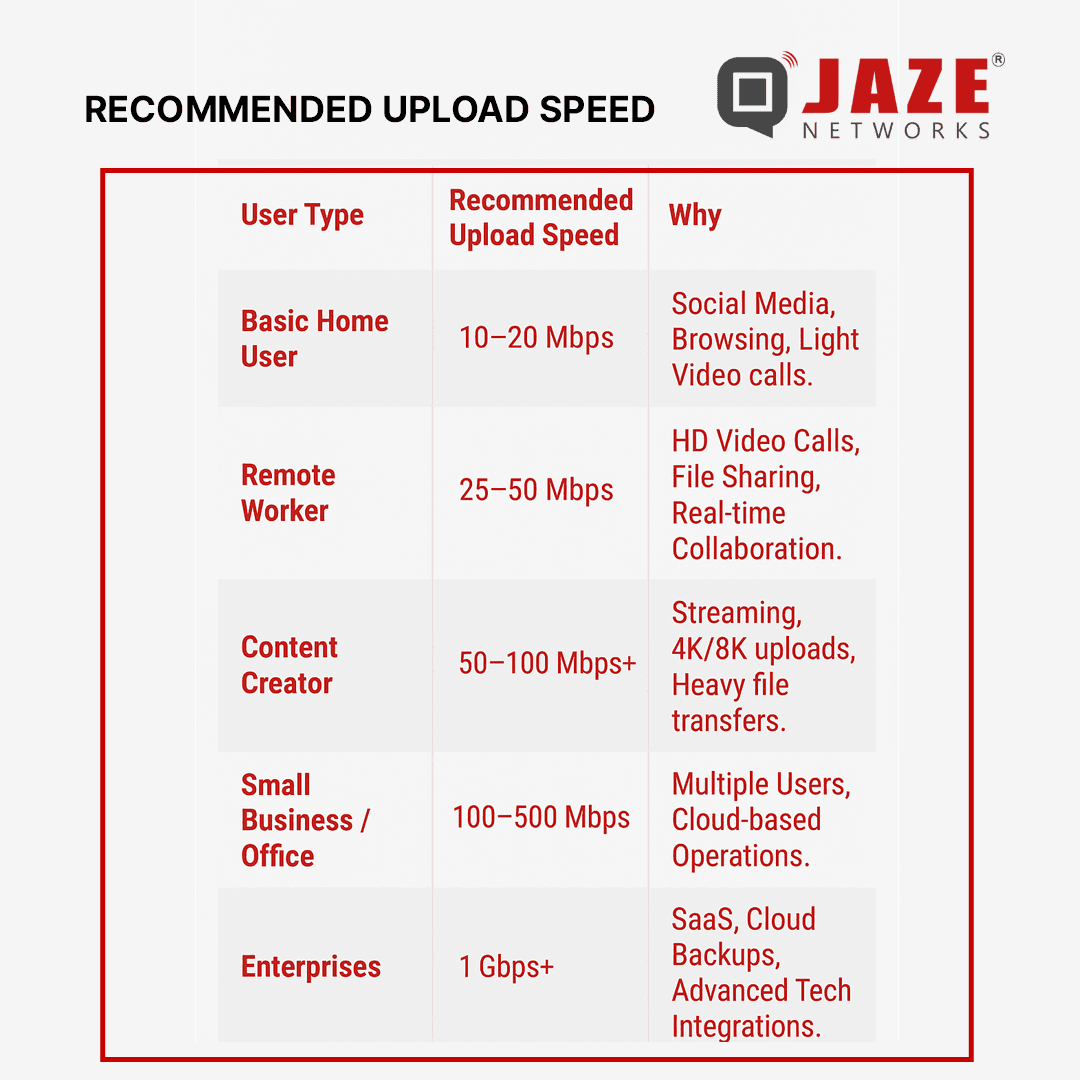
| Activity | Upload |
|---|---|
| Video calls | 3–5 Mbps |
| Online gaming | 5–10 Mbps |
| Cloud backup | 10–20 Mbps |
| 4K live streaming | 20–25 Mbps |
| Large media uploads | 25 Mbps and above |
These are per activity, not per household. A house running a backup, two calls and a camera feed at once needs the sum, and the figures assume the upstream path is not already saturated.
Why the access technology decides it
Much of the asymmetry is architectural rather than commercial. Cable and DSL allocate far more capacity downstream than upstream because that is how the spectrum is divided, and no tariff change fixes it. Fibre has no such constraint, which is why symmetric or near-symmetric service is straightforward to offer over FTTH and awkward over anything else.
For an operator that makes upstream capacity a differentiator worth being explicit about. Subscribers rarely ask for upload speed by name, but they notice a call that holds steady and a backup that completes, and those are the things that determine whether a connection feels good.
Bufferbloat is worth attention alongside raw capacity. An upstream link that is merely busy, rather than full, can add substantial delay if the queue in front of it is deep, which is why sensible queue management often improves the experience more than an extra few megabits would.
Jaze ISP Manager helps operators deliver bandwidth consistently, so upload speeds stay stable, congestion eases during peak hours, and video calls, cloud backups and live streaming perform the way subscribers expect.