API Integration Explained: How Connected Systems Improve ISP Operations
The parts of an integration, three ways to connect systems, what operators actually automate, and why error handling decides whether it holds up.
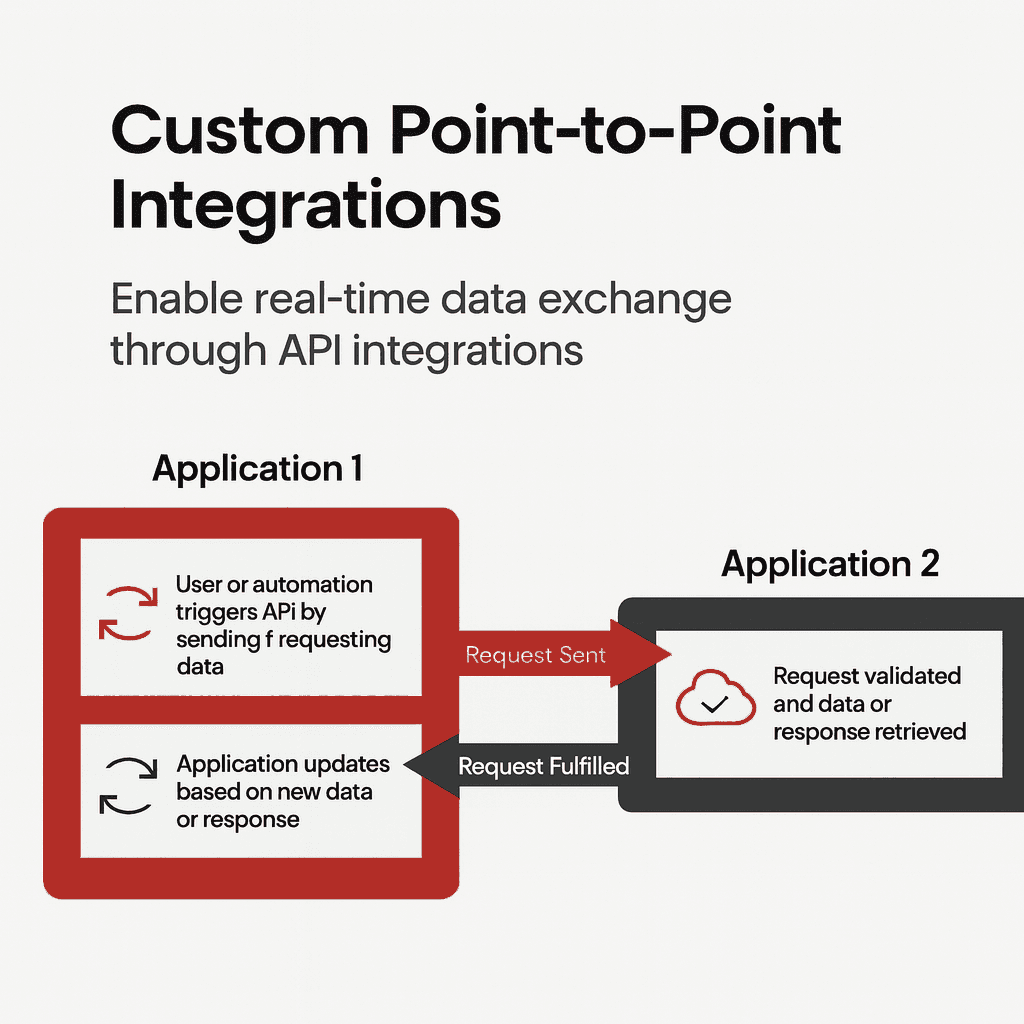
An API lets one system ask another for something and get an answer back. Put plainly, that is all an integration is. What makes it matter to an operator is what stops happening once the connection exists.
Consider a subscriber signing up. An account has to be created, a service has to be provisioned on the network, a billing record has to open and the sale has to be logged. Done by hand, that is four systems, several people and a delay measured in hours or days, with an opportunity for a transcription error at each step. Connected properly, it is one event.
The parts of an integration
- Endpoint — the address a system exposes for requests
- Request — the call itself, typically a GET, POST, PUT or DELETE
- Response — what comes back, usually JSON
- Security — authentication through keys or OAuth, transport encryption, rate limiting
- Integration logic — the mapping, transformation and error handling that sits between two systems that do not model the world identically
That last part is the one that is routinely underestimated. Two systems rarely agree on what a subscriber record looks like, and the work of reconciling them is where most of the effort goes.
Three ways to connect things
Point-to-point code. Bespoke connections written for a specific pair of systems. Direct and effective, and the maintenance cost grows with every pair added, because each connection is its own small piece of software.
Pre-built connectors. Ready-made links for common platforms. Much quicker to stand up, at the cost of flexibility where your requirements differ from the assumptions built into the connector.
Integration platforms. A layer that manages many integrations centrally and can coordinate workflows across several systems at once. More overhead to adopt and more sensible once the number of connected systems passes the point where point-to-point pairs stop being countable.
The right answer depends on how many systems are in play and how quickly the estate is changing.
What operators use them for
Onboarding and provisioning. Signup triggers provisioning directly, rather than producing a ticket for someone to action later.
Keeping records consistent. Billing, CRM, network gateways and support tools work from the same subscriber state instead of four diverging copies.
Reporting. Live figures on the network, the customer base and revenue, rather than a report assembled by hand at month end.
Adding services. Payment gateways, messaging, identity verification and content services can be attached without rebuilding the platform each time.
Reducing manual work. Fewer hands touching the same record means fewer places for it to go wrong.
Where integrations fail
They fail on error handling far more often than on the connection itself. Networks time out, systems return unexpected data, and a request that succeeds in one system while failing in the next leaves a subscriber half-created. Any integration that will run unattended needs to define what happens when a call fails, whether it can safely be retried, and who finds out when it cannot.
Versioning matters for the same reason. An API that changes shape without warning breaks every consumer at once, which is why stable contracts and deprecation notice are worth insisting on from a supplier.
Jaze ISP Manager is designed around this, connecting billing, provisioning and subscriber management so that the common operator workflows run as one flow rather than as several systems kept in step manually.