AI Data Centers Explained: Why Network Infrastructure Defines Performance
GPUs over CPUs, why thousands of processors must act as one machine, and how power, cooling and storage follow from that requirement.
Machine learning workloads have produced a distinct kind of facility, built around demands for power, cooling and network performance that a conventional data centre was never designed to meet. Understanding what separates the two explains why the network, rather than the processors, is so often the limiting factor.
A specialist, not a generalist
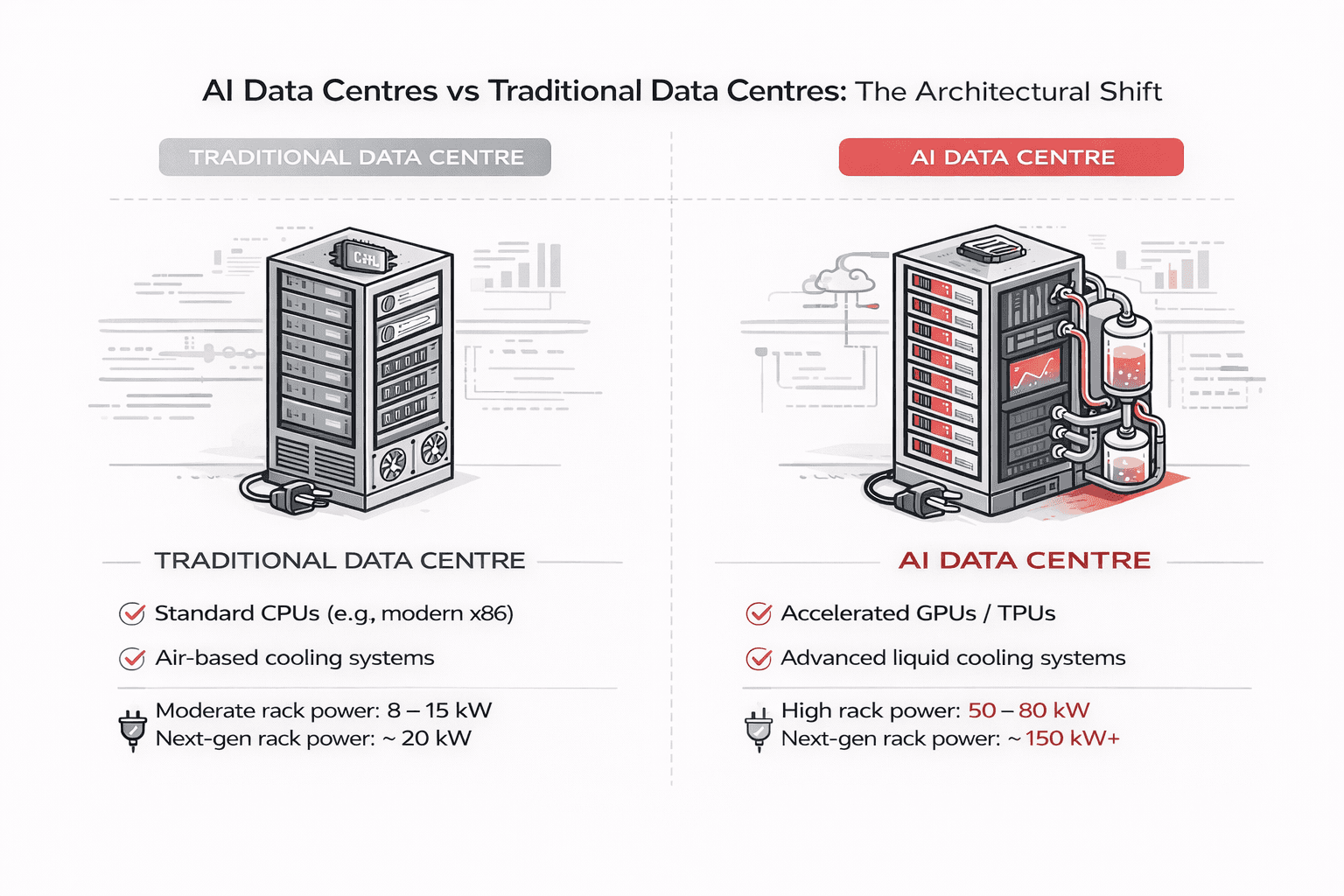
A conventional data centre is a generalist. It runs business applications, hosts sites, stores databases and handles mail, with each workload operating more or less independently at moderate intensity.
An AI facility exists to train and run neural networks at scale. That single purpose shapes every decision that follows, from the choice of processor to the design of the building.
Why the processors change
Conventional facilities are built around CPUs, which handle varied sequential work efficiently and suit a mixed application estate.
AI facilities are built around GPUs and dedicated accelerators. These carry thousands of comparatively simple cores running in parallel, which matches the repetitive arithmetic that training a model consists of. Where a CPU works through tasks in sequence, a GPU applies the same operation across an enormous number of values at once.
Why the network becomes the constraint
This is where the two diverge most sharply.
In a conventional facility, servers communicate intermittently. Standard Ethernet copes comfortably with sporadic traffic between systems that are largely independent of one another.
In an AI cluster, thousands of GPUs have to behave as one machine. During training they synchronise constantly, exchanging very large volumes of data with almost no tolerance for delay. Latency does not stay local: a few milliseconds repeated across every synchronisation step accumulates into hours of lost training time.
That places specific demands on the fabric:
- Very high bandwidth interconnects, with 400G and 800G links becoming ordinary
- Switches designed for low and predictable latency under this traffic pattern
- Traffic management deliberate enough to prevent congestion forming
- Monitoring detailed enough to locate a problem while it is happening
Without that fabric, a cluster representing an enormous hardware investment runs at a fraction of its capability.
Power and cooling
Dense computation produces heat in proportion. A standard rack draws something like 5 to 10 kilowatts; an AI-optimised rack can draw ten times that from a single cabinet.
Air cooling does not remove heat at that density, so these facilities turn to liquid cooling with cold plates mounted directly on the processors, immersion cooling where hardware runs submerged in a non-conductive fluid, and the heat exchange infrastructure that either approach requires.
Storage
Training consumes very large datasets. The access pattern is unlike a transactional database: it behaves more like a conveyor, feeding continuous streams to thousands of workers at once.
That favours parallel file systems tuned for sequential throughput, NVMe arrays for low latency, and storage networks kept separate from compute traffic. The difficulty is not locating the data but moving it fast enough that the processors never wait.
Why it matters beyond the facility
For operators and carriers, these facilities are becoming significant sources of demand on regional and backbone capacity, and their traffic profile is unusually sustained. Planning for them is closer to planning for a large transit customer than for an enterprise tenant.
As AI pushes bandwidth demand up, broadband consumption rises with it, and so does the load on the billing and logging systems behind every subscriber. Jaze ISP Manager is built on a scalable architecture that absorbs that growth without a matching investment in hardware, which is what large ISP networks need as their traffic keeps climbing.