





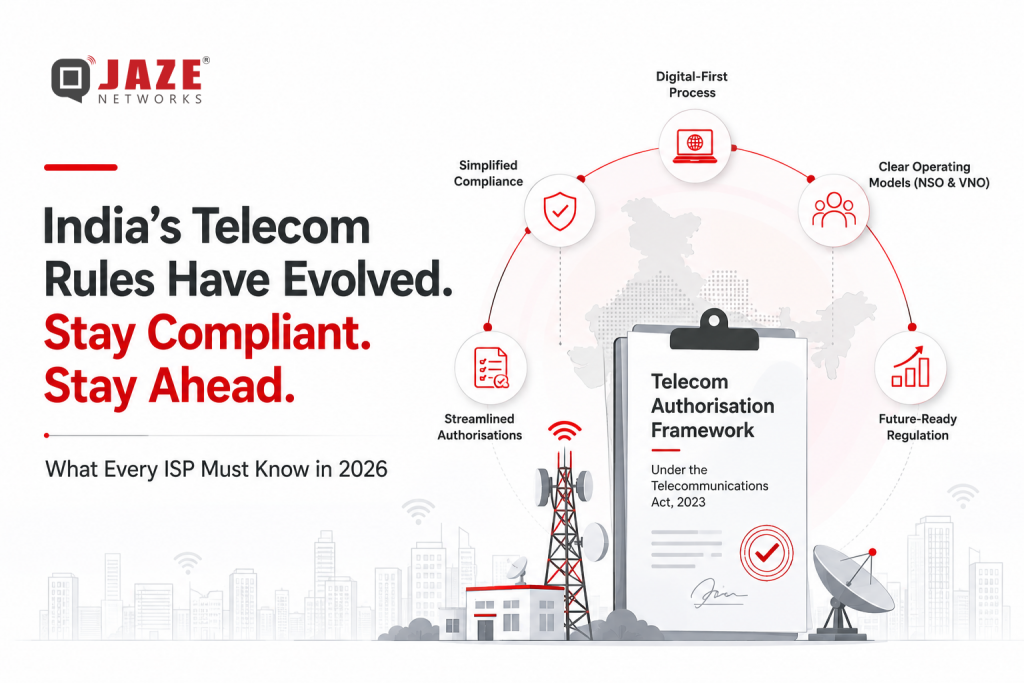
India’s telecom industry has entered a new regulatory era. For years, Internet Service Providers (ISPs), telecom operators, and Virtual Network Operators (VNOs) operated under the Unified Licence (UL) framework. That system has now been replaced with a modern telecom authorisation model under the Telecommunications Act, 2023, bringing one of the biggest regulatory changes the industry has seen in decades.
For existing operators, this means understanding a new compliance structure. For new entrants, it presents an opportunity to enter the market through a more streamlined and digital-first process.
In this article, we’ll explain what has changed, why it matters, and how ISPs can prepare for the transition.
Why Did India Replace the ISP Licence System?
The traditional licensing framework was introduced when telecom services were primarily voice-centric. Over time, the industry evolved rapidly with fiber broadband, cloud services, enterprise connectivity, IoT, private networks, and satellite communications becoming mainstream.
Managing these diverse services under multiple licence agreements gradually increased administrative complexity.
To simplify regulation and align with the Telecommunications Act, 2023, the Department of Telecommunications (DoT) introduced the Telecommunications (Authorisation for Provision of Principal Telecommunication Services) Rules, 2026, replacing the legacy licence-based approach with a statutory authorisation framework.
The objective is straightforward:
- Simplify regulatory compliance
- Improve ease of doing business
- Digitise approval processes
- Create a technology-neutral regulatory framework
- Support future telecom innovations
Licence vs Authorisation: What’s the Difference?
Although both allow companies to provide telecom services, the regulatory approach has changed significantly.
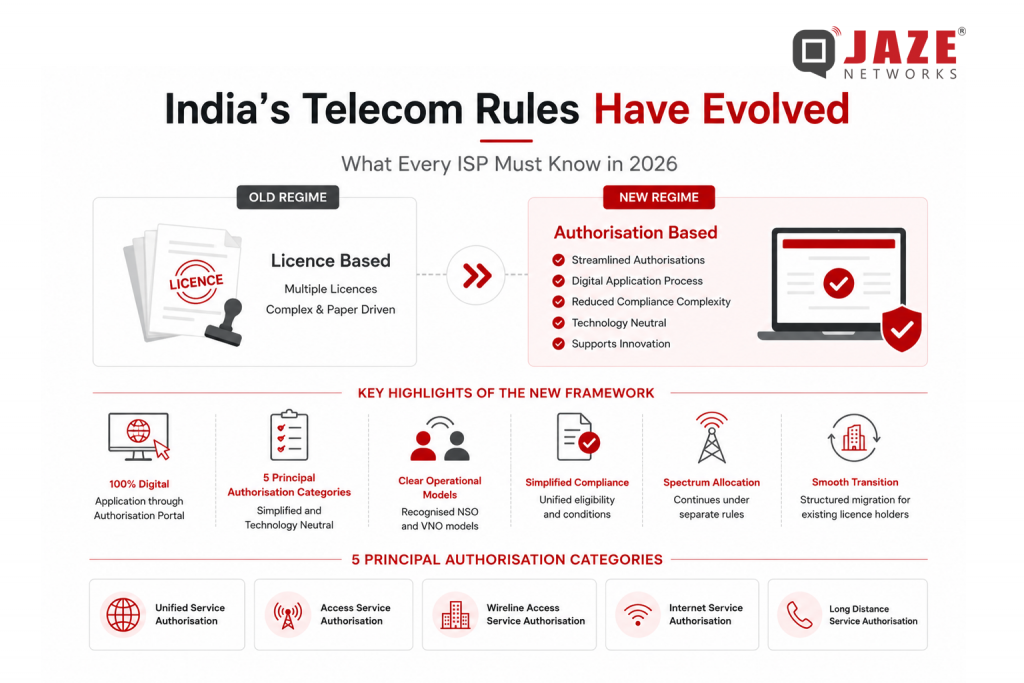
Under the previous model, operators received a licence governed by detailed contractual agreements.
Under the new framework, companies receive a government authorisation after satisfying prescribed eligibility requirements. Instead of relying on multiple licence documents and amendments, the rules are now governed through a unified statutory framework.
For businesses, this means fewer overlapping documents and greater regulatory clarity.
A Fully Digital Application Process
One of the most noticeable improvements is the introduction of a dedicated online Authorisation Portal.
Instead of managing physical paperwork, multiple submissions, and manual approvals, applicants can complete most regulatory activities digitally, including:
- Applying for telecom authorisations
- Uploading required documents
- Receiving approvals
- Managing compliance submissions
- Migrating existing licences
The move towards digital governance is expected to reduce processing time while improving transparency for applicants.
New Categories Replace Multiple Licence Structures
Rather than maintaining numerous licence types, the new rules organise telecom services into five principal authorisation categories:
- Unified Service Authorisation
- Access Service Authorisation
- Wireline Access Service Authorisation
- Internet Service Authorisation
- Long Distance Service Authorisation
This simplified structure allows operators to clearly identify the authorisation required for their business model while reducing regulatory overlap.
Clear Recognition of NSOs and VNOs
The new framework also formally distinguishes between two different operating models:
Network Service Operator (NSO)
An NSO builds, owns, and manages telecom infrastructure such as fiber networks, switching systems, and transmission equipment.
Virtual Network Operator (VNO)
A VNO delivers telecom services by utilising infrastructure leased from an NSO, allowing businesses to enter the market without investing heavily in physical network infrastructure.
This clearer separation helps businesses choose the model that best aligns with their investment strategy and operational goals.
What Happens to Existing ISP Licence Holders?
Existing licence holders are not required to stop operations.
Instead, the government has introduced a structured migration process that allows operators to transition from the legacy Unified Licence framework to the new authorisation regime when appropriate. Applications for migration are available through the DoT Authorisation Portal.
This approach ensures service continuity while giving operators adequate time to complete regulatory formalities.
Simplified Compliance Requirements
Another major improvement is the consolidation of eligibility and compliance requirements.
Instead of referring to multiple guidelines and amendments, applicants now have a single framework covering:
- Financial eligibility
- Net worth requirements
- Foreign investment compliance
- Regulatory obligations
- Authorisation conditions
For businesses expanding across multiple telecom services, this reduces uncertainty and simplifies long-term compliance planning.
Spectrum Allocation Still Follows Separate Rules
A common misconception is that obtaining an authorisation automatically grants spectrum access.
That is not the case.
Spectrum assignment continues to be managed independently through existing government allocation mechanisms. An organisation must still satisfy separate spectrum-related requirements wherever applicable.
Why This Matters for ISPs
For Internet Service Providers, these reforms go beyond regulatory terminology.
A simpler authorisation framework can reduce administrative effort, improve transparency, and make expansion into new service categories more straightforward.
As broadband demand continues to rise across residential, enterprise, rural, and industrial sectors, operators need a regulatory environment that supports faster deployment without unnecessary procedural complexity.
The new framework also complements India’s ongoing investments in fiber infrastructure, digital public services, 5G expansion, and future communication technologies.
Preparing for the Transition
Whether you’re launching a new ISP, expanding your telecom business, or managing an existing network, now is the right time to review your regulatory strategy.
Key preparation steps include:
- Understanding which authorisation applies to your services.
- Reviewing eligibility and financial requirements.
- Planning migration if you currently operate under a legacy licence.
- Updating internal compliance processes.
- Monitoring future DoT notifications as implementation evolves.
Early preparation can help minimise disruption while ensuring continued compliance with the latest regulatory requirements.
India’s move from telecom licences to a modern authorisation framework represents more than a regulatory update—it reflects the country’s broader vision of building a digitally enabled, innovation-friendly telecom ecosystem.
For ISPs, telecom operators, and VNOs, the changes introduce a more transparent, technology-neutral, and digitally managed regulatory environment. While adapting to any new framework requires planning, the long-term benefits include simplified compliance, improved operational efficiency, and easier participation in India’s rapidly expanding digital economy.
Jaze ISP Manager is a comprehensive OSS/BSS platform designed to help ISPs streamline subscriber management, automated billing, AAA, CRM, inventory, franchise management, compliance, and day-to-day network operations—all from a single platform. Whether you’re launching a new ISP or scaling an existing business under the new telecom authorisation framework, Jaze ISP Manager provides the tools needed to operate efficiently and stay future-ready.
Learn more about Jaze ISP Manager and explore its complete suite of ISP management solutions.