





Two of the most commonly used connection protocols are PPPoE (Point-to-Point Protocol over Ethernet) and IPoE (Internet Protocol over Ethernet).
While both protocols serve the same purpose—providing internet connectivity—they operate differently and offer unique advantages. Understanding these differences helps ISPs, network administrators, and even broadband users make informed decisions about their network infrastructure.
What is PPPoE?
PPPoE, or Point-to-Point Protocol over Ethernet, is a protocol that combines the Point-to-Point Protocol (PPP) with Ethernet networks. It was originally designed to support broadband services such as DSL and later became widely used by fiber ISPs as well.
With PPPoE, subscribers must authenticate using a username and password before accessing the internet. Once authenticated, a dedicated session is established between the customer’s router and the ISP’s Broadband Network Gateway (BNG). This session-based approach allows ISPs to manage subscribers individually for authentication, accounting, bandwidth control, and billing.
What is IPoE?
IPoE, short for Internet Protocol over Ethernet, is a newer and simpler method of delivering internet connectivity. Instead of requiring login credentials, IPoE automatically assigns an IP address using DHCP (Dynamic Host Configuration Protocol).
The connection process is faster because there is no authentication handshake or session establishment. This makes IPoE particularly suitable for modern fiber broadband, IPTV services, and high-speed residential networks. Many next-generation broadband deployments now prefer IPoE due to its simplicity and improved efficiency.
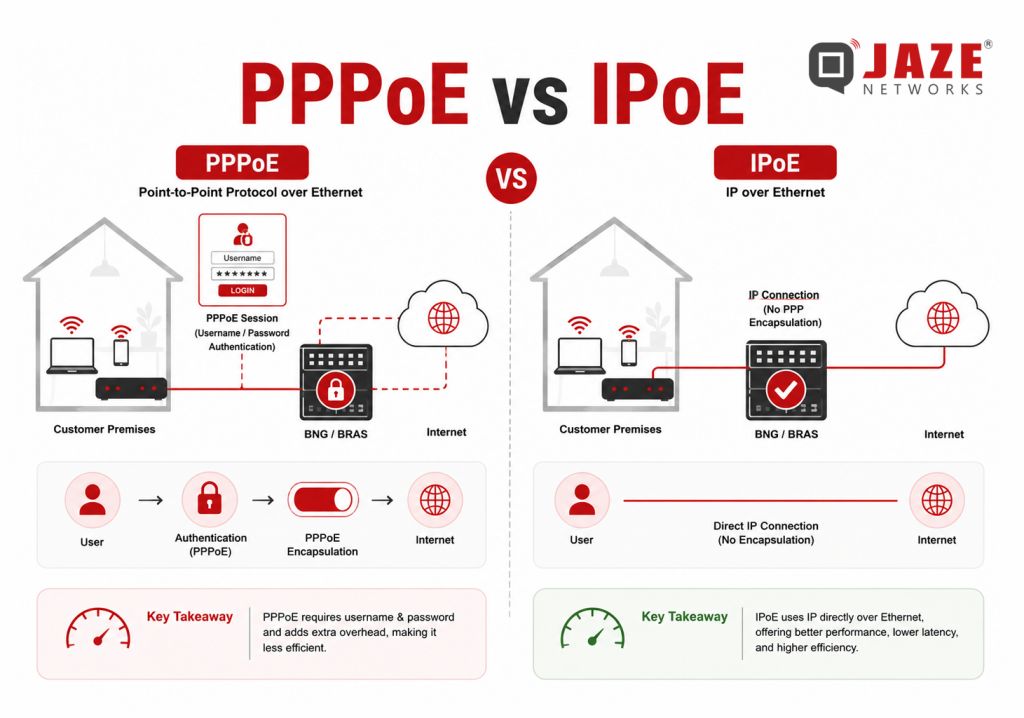
PPPoE vs IPoE: Major Differences
Although both protocols deliver internet access, they differ in several important areas.
1. Authentication
The most noticeable difference is how users are authenticated.
- PPPoE requires a username and password for every subscriber.
- IPoE relies on DHCP and network identification methods such as MAC address, VLAN, or DHCP options instead of user credentials.
For ISPs, PPPoE provides stronger per-user authentication, while IPoE simplifies the customer experience.
2. Connection Speed
PPPoE establishes a dedicated session before transmitting data, which introduces additional processing.
IPoE eliminates this extra step, allowing devices to receive an IP address almost immediately after connecting to the network. This results in quicker connection times and lower processing overhead.
3. Network Performance
PPPoE adds an additional protocol header to every packet, reducing the standard Ethernet Maximum Transmission Unit (MTU) from 1500 bytes to 1492 bytes. Although the performance impact is usually small, it can become noticeable in high-speed networks.
IPoE uses the full Ethernet MTU and avoids extra encapsulation, making it more efficient for gigabit and multi-gigabit broadband services.
4. Scalability
Modern broadband networks often serve thousands—or even millions—of subscribers.
Since PPPoE maintains individual sessions for every user, network devices must manage significantly more session information.
IPoE is largely stateless, making it easier for ISPs to scale their infrastructure while reducing the processing load on Broadband Network Gateways (BNGs).
5. IPTV and Multicast Support
Many ISPs now offer IPTV alongside broadband services.
IPoE supports multicast traffic more efficiently through technologies such as IGMP, allowing multiple users to receive the same video stream without duplicating traffic.
PPPoE can support IPTV, but multicast delivery is generally less efficient and often requires additional configuration.
Comparison Table
| Feature | PPPoE | IPoE |
| Full Form | Point-to-Point Protocol over Ethernet | Internet Protocol over Ethernet |
| Authentication | Username and Password | DHCP-based |
| Connection Type | Session-based | Connectionless |
| MTU Size | 1492 Bytes | 1500 Bytes |
| Performance | Slight protocol overhead | Lower overhead |
| Scalability | Moderate | High |
| IPTV Support | Limited multicast efficiency | Native multicast support |
| Best For | DSL, legacy broadband, controlled subscriber management | Fiber broadband, IPTV, high-speed networks |
Advantages of PPPoE
PPPoE continues to be widely used because it offers several operational benefits for ISPs:
- Strong subscriber authentication
- Easy integration with RADIUS servers
- Detailed accounting and billing
- Per-user bandwidth management
- Mature and widely supported technology
For networks where subscriber authentication and billing accuracy are top priorities, PPPoE remains a reliable choice.
Advantages of IPoE
IPoE has become increasingly popular due to its simplified architecture and improved efficiency.
Its benefits include:
- Faster connection establishment
- Lower CPU utilization
- Full Ethernet MTU support
- Better scalability
- Improved IPTV and multicast performance
- Simplified customer setup with no login credentials
These advantages make IPoE an excellent option for modern fiber access networks.
Which Protocol Should ISPs Choose?
There is no universal answer because the right protocol depends on network design and operational requirements.
PPPoE is often preferred when ISPs require strict subscriber authentication, detailed accounting, and session-based policy control. Many legacy DSL deployments and existing broadband infrastructures continue to rely on PPPoE because it integrates seamlessly with established AAA systems.
IPoE is generally better suited for new fiber deployments, GPON, XGS-PON, and large-scale broadband networks where simplicity, scalability, and higher throughput are key priorities. It also delivers a smoother experience for subscribers by eliminating manual login requirements.
Both PPPoE and IPoE are proven technologies that continue to play important roles in broadband networking. PPPoE offers strong authentication, granular subscriber management, and robust billing integration, making it valuable for many existing ISP environments. IPoE, on the other hand, delivers faster connections, lower protocol overhead, and greater scalability, making it the preferred choice for modern fiber broadband networks.
Whether your network runs on PPPoE, IPoE, or a combination of both, your BSS/OSS platform should be capable of managing subscribers seamlessly across either deployment. Jaze ISP Manager is designed to integrate with leading BNGs and access networks, enabling ISPs to manage subscriber authentication, billing, bandwidth policies, and service provisioning from a single platform. This gives operators the flexibility to support existing PPPoE subscribers while smoothly adopting IPoE as their networks evolve.
Click here to learn more.