





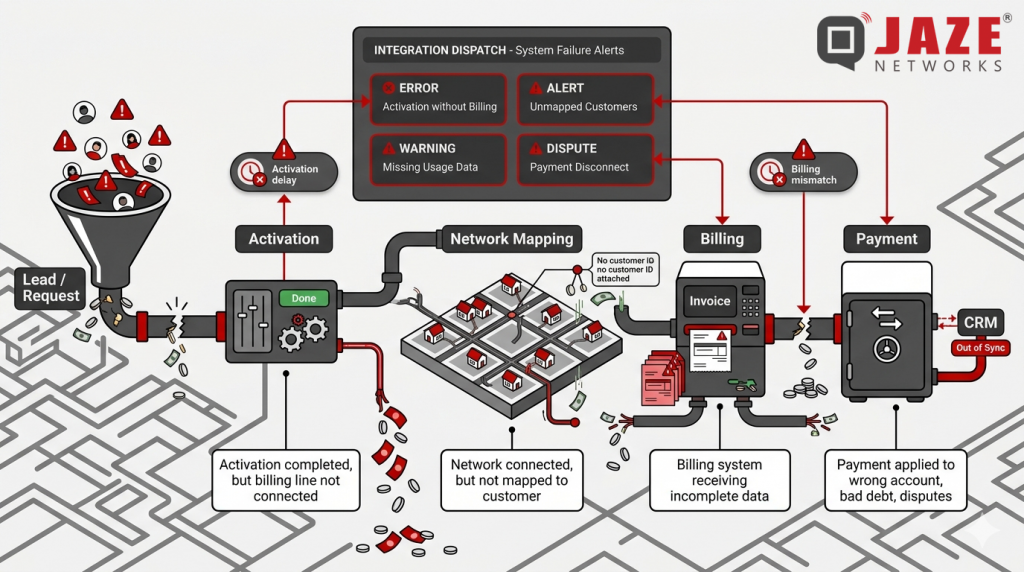
Most ISPs don’t lose money in obvious ways. There’s no single point where revenue suddenly drops. Instead, losses happen quietly across the lifecycle—from the moment a customer shows interest to the point where payment is collected.
Understanding this lifecycle is key. Because what looks like a finance problem is often an operations and visibility problem in disguise.
1. The Lead-to-Connection Gap: Where Delays Begin
Revenue doesn’t start when a customer signs up—it starts when they are activated. But in many ISPs, the time between:
- Customer inquiry
- Site survey
- Installation
- Activation
…is longer than it should be.
Every delay here pushes revenue further out. Worse, poor coordination between sales and field teams can result in:
- Missed installations
- Duplicate efforts
- Lost prospects
Speed in this phase directly impacts how quickly revenue begins.
2. Activation Without Accountability
In an ideal system, activation should trigger everything else—billing, service tracking, and monitoring.
But in reality:
- Activation updates are manual
- Billing teams rely on internal communication
- Some connections go live without being recorded properly
This creates a dangerous scenario: services are delivered, but not monetized on time.
3. The Invisible Layer: Network vs Customer Mapping
One of the most overlooked areas is the disconnect between:
- Physical network (fiber routes, splitters, nodes)
- Customer connections
When these are not mapped together:
- ISPs can’t validate which customers are active on which lines
- Troubleshooting becomes slower
- Billing accuracy is compromised
This lack of visibility creates both operational inefficiency and financial ambiguity.
4. Service Complexity Without System Control
Modern ISPs no longer offer just broadband. Today’s offerings include:
- High-speed internet plans
- OTT subscriptions
- Voice services
- Add-ons and upgrades
The challenge isn’t selling these services—it’s managing them.
Without structured systems:
- Add-ons may not be billed correctly
- Plan changes aren’t updated in real time
- Discounts continue beyond their intended duration
Over time, this creates a gap between what is delivered and what is charged.
5. Field Reality vs System Records
In growing ISPs, there’s often a mismatch between:
- What field technicians know
- What the system reflects
For example:
- A line may be re-routed, but not updated
- A customer may be shifted to a different splitter
- Temporary fixes become permanent setups
When field updates are not captured digitally, systems become unreliable. And when systems are unreliable, billing and planning both suffer.
6. The Slow Drift in Billing Accuracy
Billing errors rarely happen overnight. They build gradually due to:
- Legacy plans still active
- Manual overrides
- Inconsistent data entry
At first, the impact is small. But across hundreds or thousands of users, even minor discrepancies can significantly affect revenue.
The real issue is not incorrect billing—it’s lack of standardization.
7. Collections: The Final Bottleneck
Even when everything else works, revenue is only realized when payments are collected.
Common challenges include:
- No structured follow-up system
- Limited visibility into unpaid invoices
- Dependency on manual tracking
This leads to delayed payments and increased outstanding balances.
At scale, this affects not just cash flow—but also the ability to reinvest in network expansion.
8. Growth Without Visibility Is Risky
Many ISPs focus heavily on expansion:
- More areas
- More customers
- More services
But without visibility into operations:
- Issues multiply silently
- Teams rely on assumptions instead of data
- Decision-making becomes reactive
Growth without control doesn’t just reduce efficiency—it directly impacts profitability.
Bringing It All Together: Why Systems Matter More Than Effort
Most of these problems are not due to lack of effort. Teams are working hard across departments.
The real issue is fragmentation.
To improve financial performance, ISPs need:
- Connected workflows from lead to billing
- Real-time updates from field to system
- Clear mapping between network and customers
- Automated billing triggers based on activation
- Centralized visibility across operations
When these elements are in place, revenue becomes predictable—not accidental.
Revenue leakage in ISPs is rarely caused by a single issue—it’s the result of gaps between activation, network visibility, and billing workflows.
Jaze ISP Manager addresses this by tightly integrating customer lifecycle, service provisioning, and billing into a unified system. With activation-linked billing, real-time data synchronization, and structured service tracking, ISPs can eliminate unbilled usage and reduce dependency on manual reconciliation.
By ensuring every active connection is mapped, monitored, and billed accurately, Jaze ISP Manager helps operators maintain financial control while scaling operations efficiently.
Click here to see how Jaze ISP Manager helps ISPs eliminate revenue leakage and streamline billing operations.