




For most people, accessing the Internet is as simple as connecting to Wi-Fi or switching on mobile data. Within seconds, websites load, videos stream, and messages are delivered across the world. But behind every click lies a sophisticated infrastructure that spans continents and connects thousands of independent networks.
Contrary to popular belief, the Internet is not a single network owned by one company or government. Instead, it is a global ecosystem of interconnected networks, each managed independently but designed to work together. Internet Service Providers (ISPs), backbone carriers, Internet Exchange Points (IXPs), and routing protocols all play a vital role in ensuring data reaches its destination quickly and reliably.
Understanding how these components interact provides valuable insight into how the Internet functions at scale.
The Internet is built on thousands of Autonomous Systems (AS). An Autonomous System is a collection of IP networks managed by a single organization under a unified routing policy. Every major ISP, cloud provider, content platform, and enterprise network typically operates its own Autonomous System and is identified by a unique Autonomous System Number (ASN).
For example, telecom operators, cloud providers, and global technology companies each maintain their own AS, allowing them to exchange routing information with other networks across the Internet.
Instead of one central authority deciding where traffic should go, every Autonomous System communicates with neighboring networks to determine the best available path for data. This decentralized architecture is one of the reasons the Internet remains scalable, resilient, and capable of handling billions of connected devices.
When a user types a website address into a browser, the request does not travel directly to the destination server. It passes through multiple interconnected networks before reaching the hosting provider and returning the requested content.
This journey is made possible by the Border Gateway Protocol (BGP), often referred to as the routing protocol of the Internet.
BGP enables Autonomous Systems to exchange information about available network routes. Each network advertises the IP address ranges it can reach, allowing neighboring networks to build routing tables and determine the most suitable path for Internet traffic.
The chosen route is not always the shortest in terms of physical distance. Instead, BGP considers routing policies, network availability, commercial agreements, and overall path efficiency. If one route becomes unavailable due to maintenance or an outage, traffic can automatically be redirected through an alternate path, helping maintain uninterrupted connectivity.
Not all Internet Service Providers perform the same role within the Internet ecosystem. They are broadly categorized into different tiers based on the scale of their infrastructure and how they exchange Internet traffic.
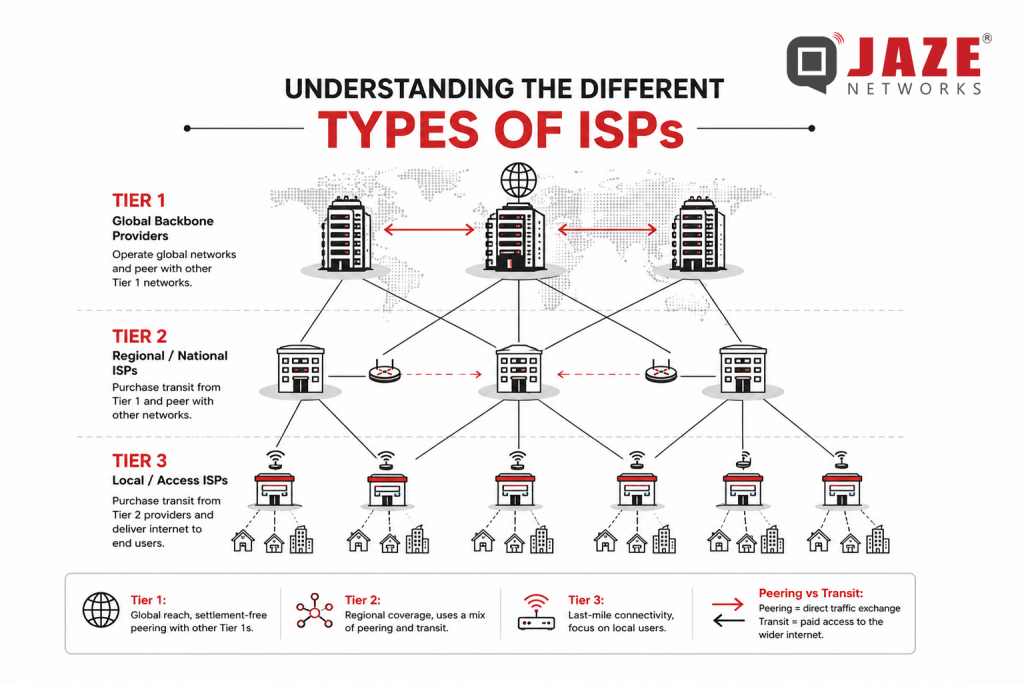
Tier 1 providers operate global backbone networks and exchange traffic directly with other Tier 1 providers without paying transit fees. They form the core of the global Internet.
Tier 2 providers combine direct peering with transit services purchased from larger networks. Many national telecom operators fall into this category, balancing operational efficiency with broader connectivity.
Tier 3 providers are typically regional or local ISPs that deliver Internet services directly to residential and business customers. These providers obtain upstream connectivity from larger networks while focusing on customer service, last-mile connectivity, and subscriber management.
Although this hierarchy simplifies the Internet’s structure, modern connectivity is far more interconnected than a strict three-tier model.
One of the key reasons the Internet operates efficiently is the relationship between peering and IP transit.
Peering is an agreement between two networks to exchange traffic directly, reducing unnecessary routing through third-party providers. This helps improve performance while lowering bandwidth costs.
IP transit, on the other hand, allows a network to purchase access to the wider Internet through an upstream provider. Smaller ISPs often rely on transit services to reach destinations beyond their own network.
Internet Exchange Points (IXPs) further improve efficiency by providing a neutral location where multiple ISPs and network operators can exchange traffic locally. In India, organizations like the National Internet Exchange of India (NIXI) enable domestic Internet traffic to remain within the country whenever possible, reducing latency and improving user experience.
Today, a significant portion of Internet traffic comes from streaming platforms, cloud applications, software updates, and social media services.
Instead of serving every request from a central data center, many companies use Content Delivery Networks (CDNs) to distribute content across multiple geographic locations. Frequently accessed content is cached closer to users, reducing the distance data must travel.
When users watch a video or download an application, the content is often delivered from the nearest CDN server rather than the original source. This minimizes latency, reduces congestion on backbone networks, and provides faster loading times.
CDNs have become an essential component of modern Internet infrastructure, supporting everything from video streaming and gaming to software distribution and enterprise applications.
As broadband adoption continues to grow, Internet Service Providers are expected to manage far more than network connectivity alone. They must handle subscriber onboarding, service provisioning, billing, customer support, complaint resolution, payment collection, regulatory compliance, and business reporting—all while maintaining consistent service quality.
This increasing operational complexity makes integrated management systems just as important as reliable network infrastructure. Streamlined workflows, centralized data, and real-time visibility enable providers to improve efficiency, reduce manual effort, and deliver a better customer experience.
The Internet is a remarkable example of global collaboration, built on thousands of interconnected networks working together through standardized protocols and shared infrastructure. From Autonomous Systems and BGP routing to peering agreements and Content Delivery Networks, every component contributes to the seamless digital experience users rely on every day.
While robust network infrastructure remains the foundation of connectivity, efficient business operations are equally critical for long-term success. Jaze Networks empowers Internet Service Providers with a comprehensive ISP management platform that simplifies subscriber management, billing, CRM, ticketing, franchise operations, and reporting. By bringing essential business functions into a single platform, Jaze ISP Manager helps ISPs streamline operations, improve service delivery, and scale with confidence.
Click here to learn more.
As businesses scale and their internet traffic grows, understanding the intricacies of internet interconnection becomes crucial. Two key concepts in this domain are IP peering and IP transit. Though they may seem similar, they serve different purposes in optimizing an enterprise’s internet connectivity.
IP peering is a mutual exchange of data between two internet service providers (ISPs). This arrangement is typically settlement-free, meaning neither party charges the other for the data exchanged. The primary advantage of IP peering is that it allows for direct data exchange, which can reduce latency and improve network performance. Peering can be public or private:
Public Peering: This occurs at an Internet Exchange Point (IXP), where multiple networks connect to exchange traffic. It leverages the Border Gateway Protocol (BGP) to efficiently route traffic through a single IXP.
Private Peering: This involves a dedicated connection between two networks, ideal for large volumes of traffic, offering greater control and performance compared to public peering.
However, peering requires careful management and negotiation, as each party must agree on the terms of the traffic exchange, including how much traffic is allowed and which routes are accessible.
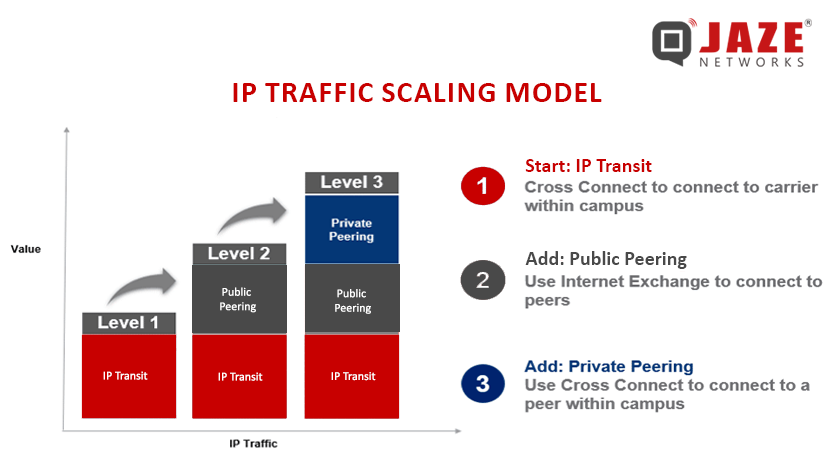
While peering is a direct relationship between two networks, IP transit is a commercial service where one network (the customer) pays another network (the provider) to deliver traffic to the rest of the internet. In essence, IP transit gives a network access to the global internet by leveraging the provider’s extensive network connections.
IP transit providers typically have large, well-connected networks with multiple peering and transit relationships, ensuring that their customers can reach any destination on the internet. The transit provider not only delivers the customer’s traffic to its final destination but also provides inbound access, allowing other networks to send traffic back to the customer.
IP transit is crucial for networks that require comprehensive internet access. Unlike peering, where traffic is exchanged only between two networks, IP transit covers the entire internet, making it essential for businesses that need to reach a global audience. This service is typically charged based on the volume of traffic sent and received, often measured in megabits per second (Mbps).
Cost Structure: IP peering is generally cost-effective as it is often settlement-free, whereas IP transit involves a recurring cost based on bandwidth usage.
Network Control: Peering provides more control over routing and can reduce dependency on third-party networks, while transit offers broader reach but less control.
Performance: Peering can enhance performance by reducing latency and potential points of failure, whereas transit ensures connectivity to a wider range of networks.
Enterprises might opt for IP peering when they have significant traffic with specific networks. For instance, if a company frequently exchanges data with another large network, peering can reduce costs and improve performance. Peering is also beneficial for content delivery networks (CDNs) and large-scale web services that require efficient and reliable data exchange.
IP transit is ideal for enterprises that need comprehensive internet access. It is particularly useful for smaller companies or those without the traffic volume to justify peering. Transit ensures that an enterprise can reach any part of the internet, making it a versatile solution for general internet connectivity.
When deciding between IP peering and IP transit, enterprises should consider their specific needs and traffic patterns. A hybrid approach, using both peering and transit, can often provide the best balance of cost, performance, and reliability. For example, an enterprise might use peering for high-volume traffic with specific networks and transit for broader internet access
ISPs can deliver bandwidth with lower latency and lower costs through peering with exchanges and content networks. This will greatly help in providing a better quality service and better end-user Internet experience. ISPs also need reliable OSS/BSS software to help deliver flexible Internet plans and manage business operations. Jaze ISP Manager in integration with BNG routers helps ISPs deliver service and manage operations. Click here for more information. Click here to learn more.