




The internet depends on thousands of interconnected networks exchanging routing information every second. This process is managed through the Border Gateway Protocol (BGP), which helps internet traffic find the best path between networks. While BGP is essential for global connectivity, it was not originally designed with built-in security mechanisms. As a result, routing mistakes and malicious route hijacking incidents can occur.
To address these challenges, network operators worldwide are increasingly adopting Resource Public Key Infrastructure (RPKI). RPKI helps verify the legitimacy of BGP route announcements, making internet routing more secure and reliable.
Resource Public Key Infrastructure (RPKI) is a framework that enables network operators to verify whether an Autonomous System (AS) is authorized to announce specific IP address prefixes.
RPKI uses digital certificates known as Route Origin Authorizations (ROAs). These certificates specify which Autonomous System Number (ASN) is permitted to advertise a particular IP prefix.
When a router receives a BGP route announcement, it can validate the announcement against available RPKI data and classify it as:
This validation process helps networks make more informed routing decisions and improves the overall security of internet routing.
BGP was built on trust. Traditionally, routers accept route announcements from neighboring networks without verifying whether the originating network is actually authorized to advertise those routes.
This creates opportunities for route hijacking and route leaks.
A route hijack occurs when a network announces IP prefixes that it does not own or control. These incidents may result from configuration errors or deliberate malicious activity.
The consequences can include:
As networks continue to grow in size and complexity, preventing these routing incidents has become increasingly important.
Without RPKI validation, routers typically rely on BGP announcements received from peers and upstream providers. If an unauthorized network advertises a more specific route, some routers may mistakenly prefer that route.
For example:

With RPKI in place, routers can verify whether the announcing ASN has authorization through a valid ROA.
If the route does not match the authorized ASN and prefix combination, it can be marked as invalid and rejected according to routing policies.
This helps prevent unauthorized route advertisements from influencing traffic flow across the internet.
RPKI provides a trusted mechanism for validating route origins before routes are accepted into the routing table. This significantly reduces the risk of route hijacking and unauthorized route announcements.
Invalid route advertisements can lead to outages and connectivity issues. By filtering invalid routes, operators can improve routing stability and maintain more consistent service delivery.
Not all routing incidents are malicious. Simple configuration mistakes can accidentally affect large portions of the internet. RPKI helps reduce the impact of these errors by validating route advertisements before they are accepted.
Reliable connectivity is critical for businesses and end users. Implementing routing security measures demonstrates a commitment to maintaining a secure and dependable network.
Major internet service providers, cloud platforms, content delivery networks, internet exchanges, and enterprise networks increasingly support RPKI validation. Adopting RPKI aligns network operations with modern routing security standards.
A typical RPKI deployment includes several components:
ROAs define which ASN is authorized to advertise a specific IP prefix.
These repositories store certificates and ROAs that can be accessed and validated by network operators.
Validators retrieve and verify RPKI data from trusted repositories and provide validation results to routers.
Routers use validation information to classify routes and apply routing policies based on whether routes are valid, invalid, or not found.
Together, these components create a framework that strengthens the trustworthiness of BGP routing information.
Organizations planning to deploy RPKI can follow these general steps:
Generate Route Origin Authorizations for owned IP prefixes through the appropriate Regional Internet Registry (RIR).
Install and configure an RPKI validator to retrieve and verify certificate information.
Configure routers to receive route validation information from the validator.
Establish routing policies for handling valid, invalid, and not-found routes.
Regularly review ROAs, routing policies, and validation status to ensure ongoing accuracy and protection.
As cloud services, broadband networks, enterprise connectivity, and internet infrastructure continue to expand, routing security is becoming a critical operational requirement.
RPKI provides a practical and effective method for improving trust in BGP route announcements. By validating route origins, network operators can reduce the risk of route hijacking, improve network reliability, and contribute to a more secure internet ecosystem.
While RPKI does not eliminate every routing threat, it represents one of the most important advancements in BGP security and is increasingly viewed as a foundational best practice for modern network operations.
Secure routing is only one part of building a reliable network. Network operators also need efficient tools for subscriber management, service provisioning, monitoring, and operational visibility.
Jaze Networks provides solutions designed to help ISPs and network operators simplify operations, improve service delivery, and manage growing network infrastructure more effectively.
Whether you’re expanding your network or modernizing existing operations, Jaze Networks can help you build a more efficient and resilient network environment. Contact us today to learn more about our ISP management and network solutions.
For most people, accessing the Internet is as simple as connecting to Wi-Fi or switching on mobile data. Within seconds, websites load, videos stream, and messages are delivered across the world. But behind every click lies a sophisticated infrastructure that spans continents and connects thousands of independent networks.
Contrary to popular belief, the Internet is not a single network owned by one company or government. Instead, it is a global ecosystem of interconnected networks, each managed independently but designed to work together. Internet Service Providers (ISPs), backbone carriers, Internet Exchange Points (IXPs), and routing protocols all play a vital role in ensuring data reaches its destination quickly and reliably.
Understanding how these components interact provides valuable insight into how the Internet functions at scale.
The Internet is built on thousands of Autonomous Systems (AS). An Autonomous System is a collection of IP networks managed by a single organization under a unified routing policy. Every major ISP, cloud provider, content platform, and enterprise network typically operates its own Autonomous System and is identified by a unique Autonomous System Number (ASN).
For example, telecom operators, cloud providers, and global technology companies each maintain their own AS, allowing them to exchange routing information with other networks across the Internet.
Instead of one central authority deciding where traffic should go, every Autonomous System communicates with neighboring networks to determine the best available path for data. This decentralized architecture is one of the reasons the Internet remains scalable, resilient, and capable of handling billions of connected devices.
When a user types a website address into a browser, the request does not travel directly to the destination server. It passes through multiple interconnected networks before reaching the hosting provider and returning the requested content.
This journey is made possible by the Border Gateway Protocol (BGP), often referred to as the routing protocol of the Internet.
BGP enables Autonomous Systems to exchange information about available network routes. Each network advertises the IP address ranges it can reach, allowing neighboring networks to build routing tables and determine the most suitable path for Internet traffic.
The chosen route is not always the shortest in terms of physical distance. Instead, BGP considers routing policies, network availability, commercial agreements, and overall path efficiency. If one route becomes unavailable due to maintenance or an outage, traffic can automatically be redirected through an alternate path, helping maintain uninterrupted connectivity.
Not all Internet Service Providers perform the same role within the Internet ecosystem. They are broadly categorized into different tiers based on the scale of their infrastructure and how they exchange Internet traffic.
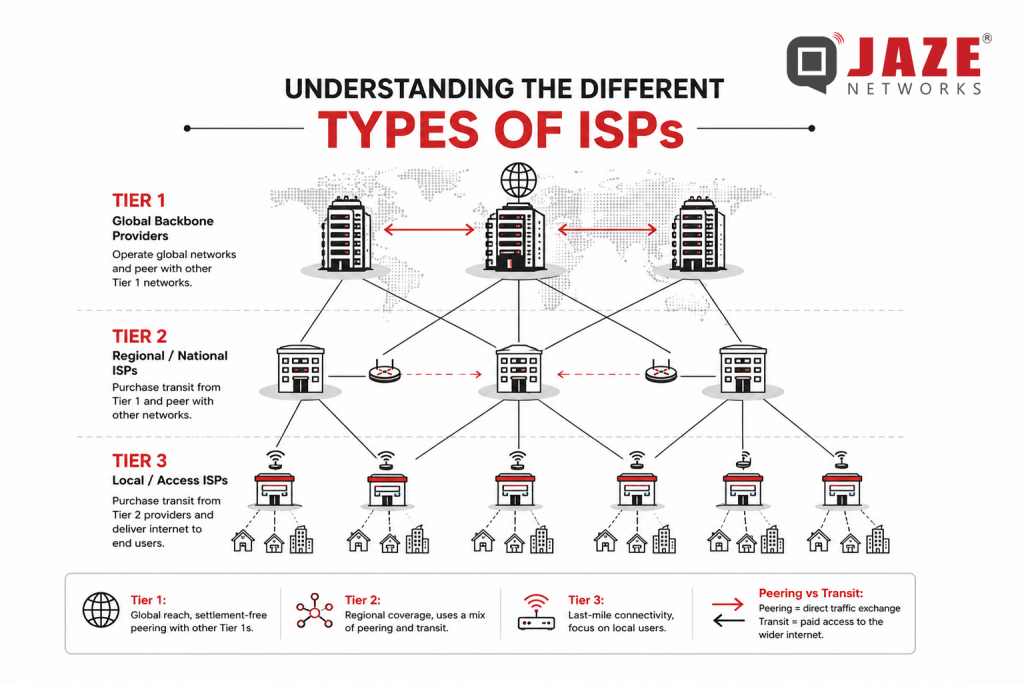
Tier 1 providers operate global backbone networks and exchange traffic directly with other Tier 1 providers without paying transit fees. They form the core of the global Internet.
Tier 2 providers combine direct peering with transit services purchased from larger networks. Many national telecom operators fall into this category, balancing operational efficiency with broader connectivity.
Tier 3 providers are typically regional or local ISPs that deliver Internet services directly to residential and business customers. These providers obtain upstream connectivity from larger networks while focusing on customer service, last-mile connectivity, and subscriber management.
Although this hierarchy simplifies the Internet’s structure, modern connectivity is far more interconnected than a strict three-tier model.
One of the key reasons the Internet operates efficiently is the relationship between peering and IP transit.
Peering is an agreement between two networks to exchange traffic directly, reducing unnecessary routing through third-party providers. This helps improve performance while lowering bandwidth costs.
IP transit, on the other hand, allows a network to purchase access to the wider Internet through an upstream provider. Smaller ISPs often rely on transit services to reach destinations beyond their own network.
Internet Exchange Points (IXPs) further improve efficiency by providing a neutral location where multiple ISPs and network operators can exchange traffic locally. In India, organizations like the National Internet Exchange of India (NIXI) enable domestic Internet traffic to remain within the country whenever possible, reducing latency and improving user experience.
Today, a significant portion of Internet traffic comes from streaming platforms, cloud applications, software updates, and social media services.
Instead of serving every request from a central data center, many companies use Content Delivery Networks (CDNs) to distribute content across multiple geographic locations. Frequently accessed content is cached closer to users, reducing the distance data must travel.
When users watch a video or download an application, the content is often delivered from the nearest CDN server rather than the original source. This minimizes latency, reduces congestion on backbone networks, and provides faster loading times.
CDNs have become an essential component of modern Internet infrastructure, supporting everything from video streaming and gaming to software distribution and enterprise applications.
As broadband adoption continues to grow, Internet Service Providers are expected to manage far more than network connectivity alone. They must handle subscriber onboarding, service provisioning, billing, customer support, complaint resolution, payment collection, regulatory compliance, and business reporting—all while maintaining consistent service quality.
This increasing operational complexity makes integrated management systems just as important as reliable network infrastructure. Streamlined workflows, centralized data, and real-time visibility enable providers to improve efficiency, reduce manual effort, and deliver a better customer experience.
The Internet is a remarkable example of global collaboration, built on thousands of interconnected networks working together through standardized protocols and shared infrastructure. From Autonomous Systems and BGP routing to peering agreements and Content Delivery Networks, every component contributes to the seamless digital experience users rely on every day.
While robust network infrastructure remains the foundation of connectivity, efficient business operations are equally critical for long-term success. Jaze Networks empowers Internet Service Providers with a comprehensive ISP management platform that simplifies subscriber management, billing, CRM, ticketing, franchise operations, and reporting. By bringing essential business functions into a single platform, Jaze ISP Manager helps ISPs streamline operations, improve service delivery, and scale with confidence.
Click here to learn more.
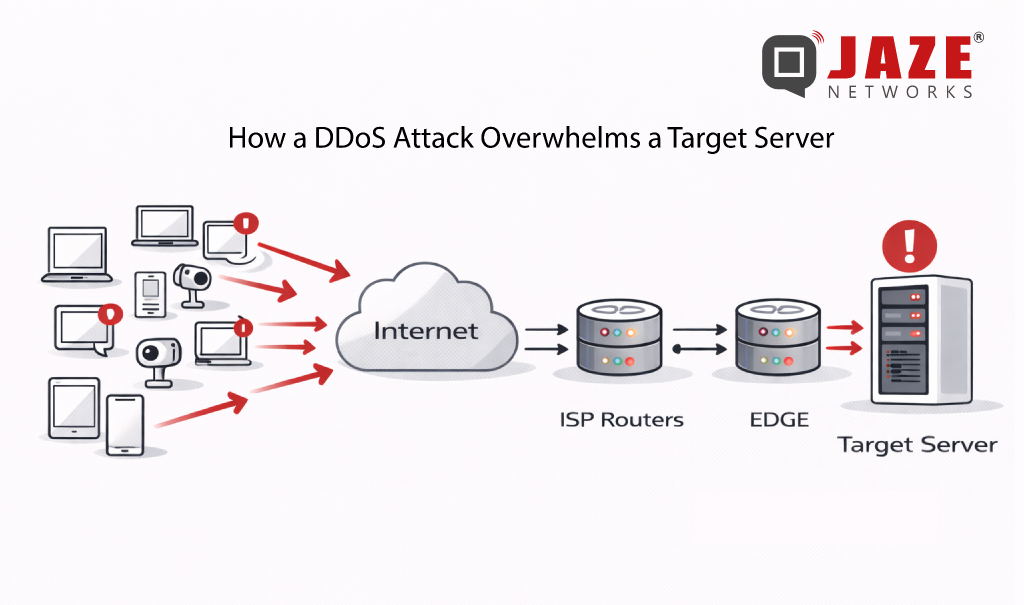
DDoS attacks are no longer rare, large-scale events. Volumetric floods exceeding hundreds of gigabits per second are now routine — and for ISPs, the damage isn’t just to the targeted subscriber. Congestion cascades across shared infrastructure, degrading service for everyone on the network. The question isn’t whether your network will face a DDoS attack. It’s how fast you can stop one.
BGP Flowspec is the answer most network operators are turning to — and for good reason. It combines the speed of BGP route propagation with the precision of granular traffic filtering, giving ISPs surgical control over attack traffic without disrupting legitimate users.
From Blunt to Precise: The Evolution Beyond RTBH
Before Flowspec, Remote Triggered Black Hole (RTBH) filtering was the go-to mitigation tool. RTBH works by routing all traffic destined for an attacked IP address to a null route — effectively dropping everything. It works fast, but it’s indiscriminate: legitimate traffic to that host gets silently discarded alongside the attack traffic.
BGP Flowspec (defined in RFC 5575 and extended in RFC 8955) was developed to solve this problem. Rather than blackholing an entire destination, Flowspec lets operators define detailed traffic rules based on multiple attributes simultaneously — and distribute those rules across the network in seconds via BGP.
What Makes BGP Flowspec Powerful
Flowspec rules can match traffic using a combination of:
• Source and destination IP addresses or prefixes
• Source and destination port numbers
• IP protocol (TCP, UDP, ICMP, etc.)
• Packet length and DSCP markings
• TCP flags (SYN, ACK, RST, etc.)
Once a rule is created, Flowspec propagates it to all BGP-peered routers — including upstream providers and transit peers — in real time. Instead of one appliance scrubbing traffic at a single point, the entire network perimeter reacts simultaneously.
Supported actions include rate-limiting specific traffic types, redirecting flows to scrubbing centers, tagging packets with DSCP values for QoS treatment, or dropping traffic outright. This flexibility makes Flowspec equally useful for volumetric UDP floods, TCP SYN attacks, and reflection/amplification attacks.
How Mitigation Works in Practice
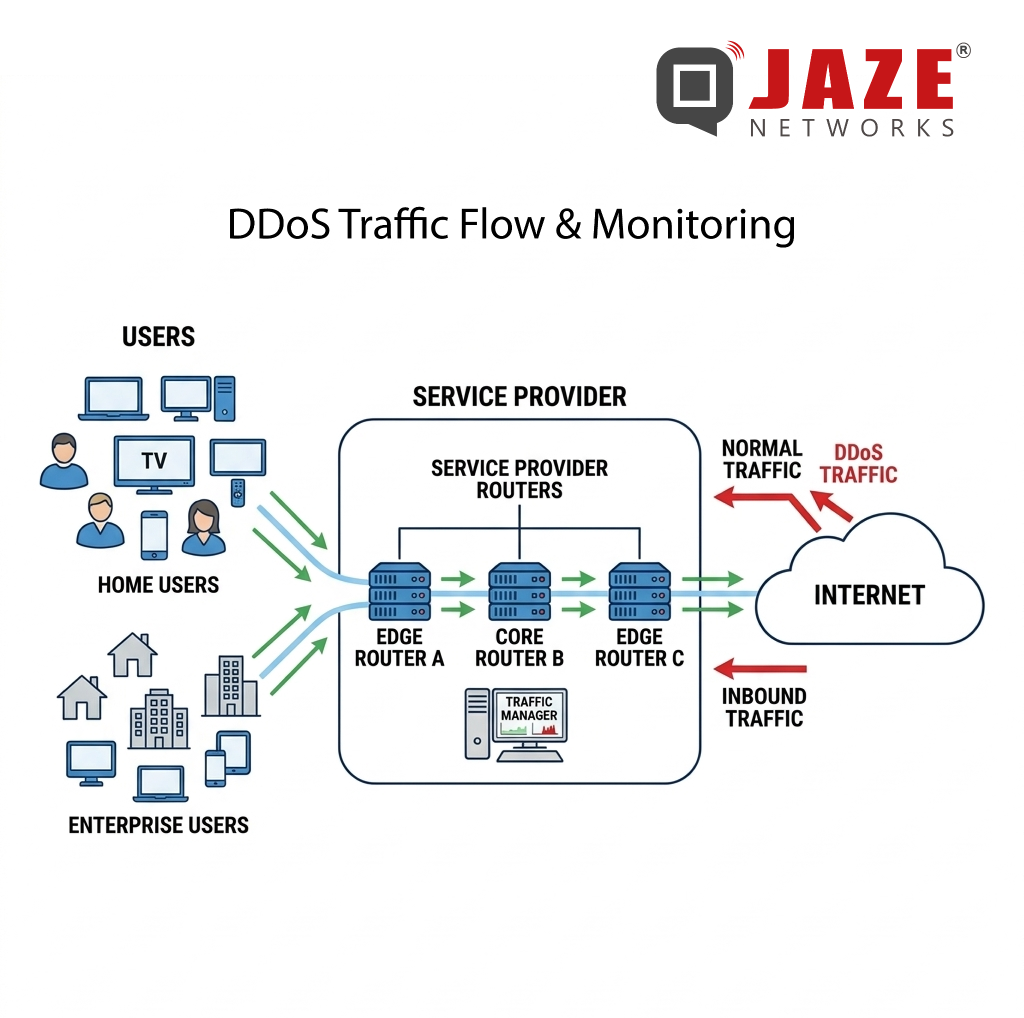
In a typical deployment, traffic telemetry — from NetFlow, IPFIX, or sFlow — is continuously analyzed by a detection system. When an attack signature is identified, the system automatically generates a Flowspec rule and announces it via BGP to all participating routers.
The entire cycle — detection, rule creation, propagation, enforcement — can complete in under 30 seconds. At attack scale, that speed is the difference between a 5-minute blip and a 45-minute outage.
Because Flowspec rules target specific traffic characteristics rather than IP addresses, legitimate users on the same subnet or hosting the same services are unaffected. The attack is blocked; normal traffic continues.
Vendor Support and Deployment Considerations
BGP Flowspec is supported across all major network equipment vendors — Cisco, Juniper, Huawei, Nokia, and Arista all implement it natively in their router operating systems. However, implementation depth varies: some platforms support only basic match criteria, while others support the full RFC 8955 attribute set.
For ISPs deploying Flowspec, key planning decisions include:
• Which routers will act as Flowspec clients (receiving and enforcing rules)
• Whether upstream transit providers also support Flowspec peering
• How detection thresholds are tuned to minimize false positives
• Whether mitigation is manual, semi-automated, or fully automated
Automated Flowspec deployment — where detection and rule announcement happen without human intervention — is now the standard approach for ISPs handling large subscriber bases. Manual processes are too slow when an attacker can saturate uplinks in seconds.
Flowspec and RTBH: Complementary, Not Competing
Flowspec doesn’t make RTBH obsolete. For attacks where the traffic source is clearly identified and the targeted IP has no legitimate inbound traffic (a server in maintenance, for example), RTBH remains faster to deploy and simpler to manage.
A mature ISP DDoS strategy uses both: RTBH for immediate, coarse-grained isolation and Flowspec for precise, sustained mitigation that preserves service availability for other subscribers on the same prefixes.
Jaze ISP Manager provides scalable IPFIX logging which can be integrated with DDoS protection systems for real-time DDoS detection and mitigation. In integration with BGP routers supporting RTBH and BGP Flowspec , ISPs can detect, respond to, and neutralise DDoS attacks before service is disrupted — keeping subscribers connected and SLAs intact.
Click here to see how Jaze ISP Manager helps in delivering scalable IPFIX logging services.