Fiber vs Satellite Internet: Which is Right for You?
Where each one wins, how low-earth-orbit changed the latency picture, and what satellite competition means for a terrestrial operator.
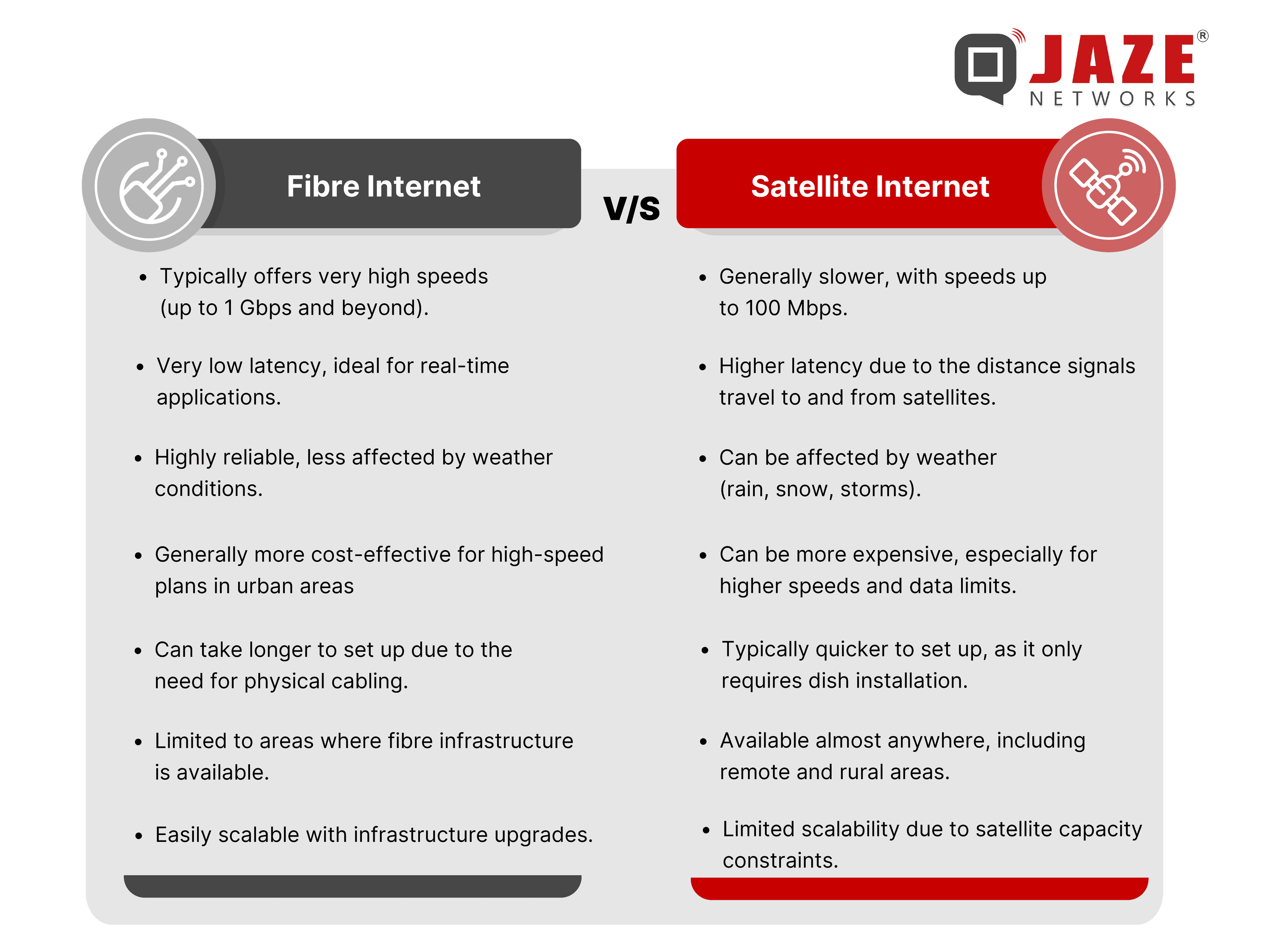
Fibre and satellite are rarely a genuine choice. For most people one of them is not available, and the decision is made by geography rather than by comparing specifications. Where both exist, the trade-offs are clear enough to settle quickly.
What fibre gives you
Capacity with headroom. Gigabit service is routine and the medium supports far more, so the connection is unlikely to be the constraint for years.
Low, steady latency. Signals travel a short physical distance through a direct path, which is what makes interactive use feel immediate.
Consistency. Fibre is unaffected by weather and does not degrade over distance the way copper does, so performance at midnight resembles performance at eight in the evening.
Longevity. The cable outlasts the electronics attached to it, and upgrades usually mean changing equipment at each end rather than digging again.
The limitation is availability. Fibre exists where someone has paid to lay it, and the cost of laying it rises sharply as density falls. Where it has not been built, no tariff makes it available, and installation in a newly covered area takes as long as the civil work takes.
What satellite gives you
Coverage. This is the entire argument and it is a strong one. Satellite reaches places no cable will reach economically, and for many rural and remote users it is the only real broadband option.
Speed of availability. No trenching, no wayleaves. Equipment is installed at the property and the service works.
Low-earth-orbit constellations have improved the picture considerably. Geostationary satellites sit far enough away that the round trip alone adds several hundred milliseconds, which makes calls awkward and real-time applications close to unusable. Orbiting much lower cuts that to something comparable with a mediocre terrestrial connection, which changed satellite from a last resort into a usable service.
It remains a shared medium with a capacity ceiling. Performance depends on how many other users are on the same cell, heavy rain degrades the link, and the dish needs a clear view of the sky, which trees and buildings interfere with.
Choosing between them
If fibre is available, take it. It is faster, steadier, cheaper to run at the same service level, and it does not care about the weather.
If it is not, the question is whether satellite is better than the alternatives actually present, which are usually fixed wireless, a mobile connection, or older copper. Against those it often compares well, particularly where copper distances are long.
For an interim period during a fibre build, satellite is a reasonable bridge, and worth treating as such rather than as a permanent arrangement.
From an operator's perspective
Satellite has changed the competitive picture in areas that were previously uncontested. A rural subscriber who would once have accepted whatever was available now has an alternative that arrives without a build.
That shifts where an operator competes. On coverage, the gap has narrowed. On latency, consistency, capacity during peak hours and price at a given service level, terrestrial fibre still holds a clear advantage, and those are the grounds worth competing on.
It also raises the value of getting a fibre subscriber connected quickly. The window between someone wanting service and someone choosing an alternative is shorter than it used to be, and a slow provisioning process is now a competitive problem rather than an internal inconvenience.